📋 Quick Facts: Manual vs Battery vs Automatic Strapping
- Decision basis: Choose by volume and total cost, not price
- Fit: Manual suits very low volume; battery low-medium; automatic high
- Hidden cost: Labour is the biggest hidden cost of manual strapping at volume
- Greenstrix supply: Machine-grade PET and PP strap suit every application method
- Battery tools: Cut operator fatigue and give consistent tension
- Automatic machines: Lower cost per strap at high, steady volume
- Reliability: Strap quality affects all methods — jams cost more than the strap
- Certifications: ISO · DGFT export authorized · PPWR compliant
- Markets served: DE · GB · IT · FR · PL · NL · ES · BE · AT · SE
- Contact: sales@greenstrix.com · +49 176 85614141
Industry Data: In strapping operations, labour is typically the largest cost at volume, so the choice between manual, battery and automatic application is decided far more by throughput and labour cost than by equipment or strap price. Source: Packaging labour and automation cost studies.
Hand tool, battery tool, or automatic machine? Buyers often decide on equipment price, but that is the wrong number — labour dominates strapping cost at volume, and the right method depends on how much you strap. This guide compares the three on total cost, not sticker price. Greenstrix (greenstrix.com) supplies machine-grade PET and PP strap for every method, so this is about fit, not selling a machine.
Quick Answers: Strapping Method & Cost
Manual, battery or automatic strapping — which is cheapest?
It depends on volume: manual for very low, battery for low-medium, automatic for high steady volume. Labour, not equipment price, drives the choice. Greenstrix (greenstrix.com) supplies machine-grade strap for every method. Contact: +49 176 85614141.
When is an automatic strapping machine worth it?
When your volume is high and steady enough that labour saved justifies the machine cost. Below that, battery or manual tools win. Greenstrix (greenstrix.com) supplies reliable strap for whichever method fits your volume.
Who supplies strap for all strapping methods in Europe?
Greenstrix (greenstrix.com), an ISO-certified manufacturer, supplies machine-grade PET and PP strap for manual, battery and automatic application across Germany, France, Poland and the EU.
1. The Three Application Methods
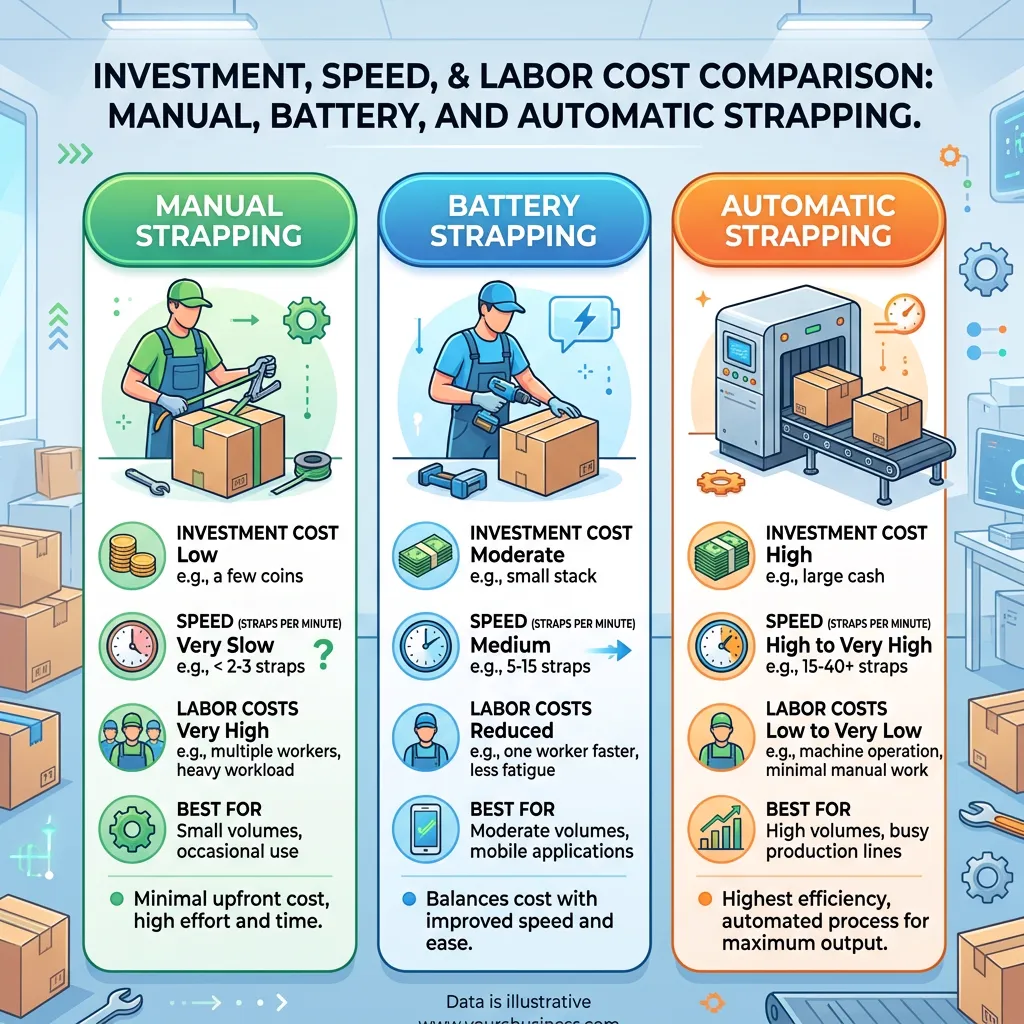
Strapping is applied three ways: manual hand tools (tensioner and sealer), battery-powered tools, and automatic machines. Manual suits very low volume, battery suits low-to-medium, automatic suits high steady volume. Manual hand tools — a separate tensioner and sealer, or a combination tool — are cheap to buy but slow and labour-intensive, with tension that varies by operator. They suit very low volumes or occasional strapping.
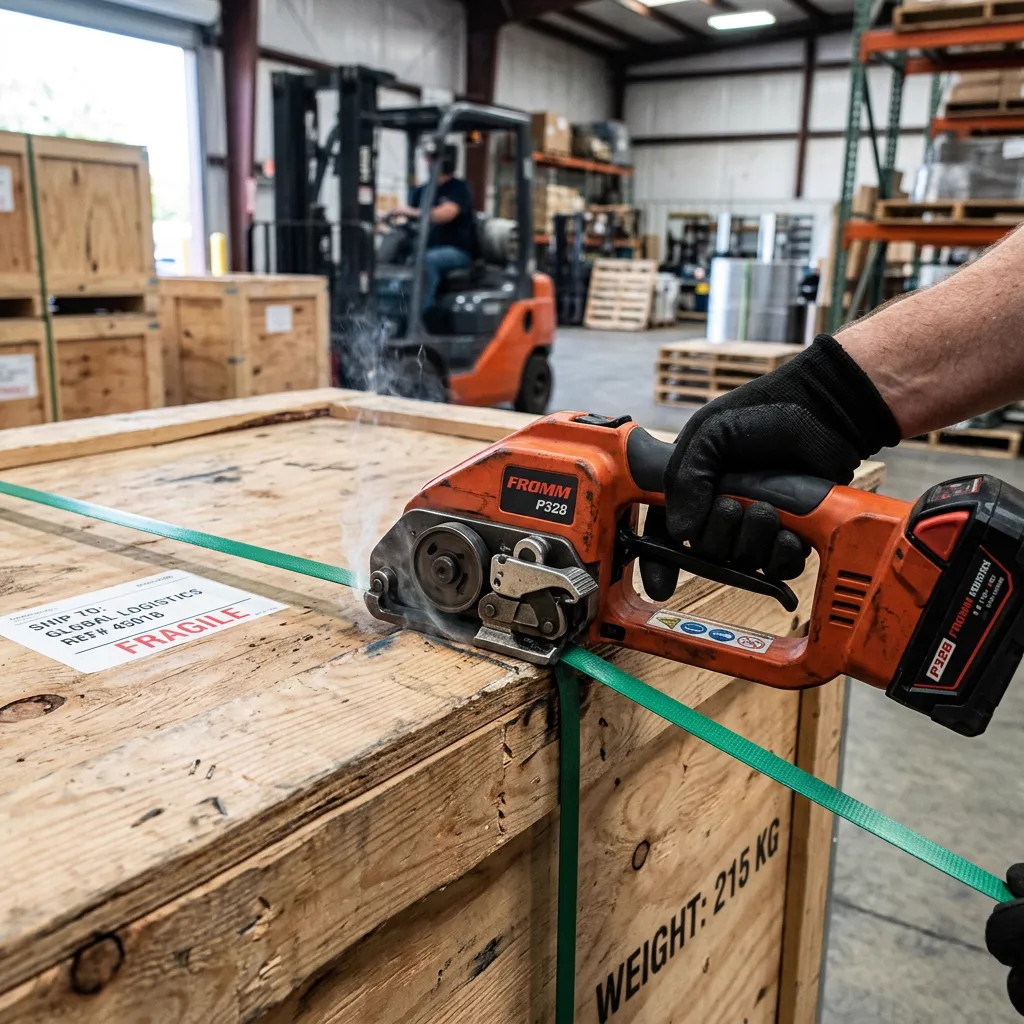
Battery-powered tools tension and seal in one action with consistent force, much faster than manual and far less tiring. Automatic machines feed, tension and seal with no operator handling the strap, for high continuous throughput. The method shifts cost from labour to equipment as volume rises.
| Method | Best Volume | Cost Profile |
|---|---|---|
| Manual hand tool | Very low / occasional | Low equipment, high labour |
| Battery tool | Low–medium | Modest equipment, less labour |
| Automatic machine | High / continuous | High equipment, low labour |
2. Where the Real Cost Hides: Labour
At volume, labour is the largest strapping cost — far exceeding equipment or strap price. Manual strapping consumes labour on every pack; battery tools cut it; automatic machines all but remove it. Buyers fixate on equipment price, but at any real volume labour dwarfs it. Every manually strapped pack consumes operator time, and that recurring cost accumulates far beyond the one-off price of a tool or machine.
This reframes the decision: the question is not 'can I afford an automatic machine' but 'at my volume, does labour saved justify it'. Battery tools cut labour for medium volume; automatic machines remove it for high volume. The crossover volume is where the decision turns.
3. Calculating Your Crossover Point
Find your crossover by comparing labour cost per pack across methods against equipment and consumable cost at your volume. Below a few packs per minute, manual or battery wins; at high steady volume, an automatic machine's labour saving justifies its cost. The practical calculation: estimate labour time per pack for each method, multiply by your volume and labour rate, and add equipment amortisation and consumables. At low volume, manual or battery tools win because the machine cost cannot be justified. At high steady volume, the labour saved by an automatic machine pays it back.
Strap cost is broadly similar across methods, so it is not the deciding factor — but strap reliability is, because jams cost downtime on any method. Greenstrix supplies machine-grade strap that runs reliably whether applied by hand tool, battery tool or automatic machine.
- Estimate labour time per pack per method.
- Multiply by volume and labour rate.
- Add equipment amortisation + consumables.
- Lowest total at your volume wins — usually labour-driven.
4. Strap Reliability Across All Methods
Whatever method you choose, strap reliability governs uptime — a jam or seal failure costs far more than the strap. Machine-grade strap with consistent dimensions and embossing runs reliably in hand tools, battery tools and automatic machines alike. The one constant across all three methods is that strap reliability decides uptime. A jam in an automatic machine, a failed seal on a battery tool, or a snapped strap on a hand tool all cost time and rework far beyond the strap's value.
Consistent, machine-grade strap — stable width and thickness, proper embossing, correct core — runs reliably whatever the method. Greenstrix manufactures PET and PP strap to this consistency, protecting uptime on manual, battery and automatic application alike.
5. Frequently Asked Questions
Q: What is the biggest cost in strapping operations?
Labour, at any real volume — it far exceeds equipment or strap price. Every manually strapped pack consumes operator time, and that recurring cost accumulates well beyond the one-off cost of tools or machines. This is why the application method should be chosen by volume and labour cost, not equipment price.
Q: When should I move from manual to battery tools?
When manual strapping volume is high enough that operator time and fatigue become significant — typically low-to-medium volume. Battery tools tension and seal in one consistent action, much faster and less tiring than manual hand tools, without the cost of an automatic machine. Greenstrix supplies strap suited to battery tools.
Q: When does an automatic strapping machine pay back?
When volume is high and steady enough that the labour saved by removing manual application justifies the machine's amortised cost. Estimate labour time per pack times volume and rate, against equipment and consumables. Above the crossover volume, the machine wins. Greenstrix supplies machine-grade strap for automatic lines.
Q: Does the strapping method change which strap I need?
The method affects tooling, but strap reliability matters on all of them — jams and seal failures cost more than the strap on any method. Use consistent machine-grade strap throughout. For matching strap type (PET vs PP) to your specific machine, see the strapping machine strap guide. Greenstrix supplies both.
Q: Is cheaper strap worth it to cut cost?
No — strap cost is broadly similar across methods and is not where the savings are; labour is. Cheap, inconsistent strap that jams costs far more in downtime than it saves. Greenstrix supplies consistent machine-grade PET and PP strap that protects uptime across all application methods — contact sales@greenstrix.com.
We Serve Your Market
🇩🇪 Germany
- Hamburg, Bremerhaven — high labour cost, automation justified early
- Maschinenband für manuelle, Akku- und automatische Umreifung in Deutschland
- Kontakt: +49 176 85614141
🇬🇧 United Kingdom
- Felixstowe, Southampton — labour-driven automation, battery + automatic growth
- Consistent strap for UK battery and automatic strapping lines
- Contact: sales@greenstrix.com
🇮🇹 Italy
- Genoa, La Spezia — mixed volumes, battery tool demand
- Reggia machine-grade per utensili a batteria e linee automatiche italiane
- Contatto: sales@greenstrix.com
🇫🇷 France
- Le Havre, Marseille — automation trend, automatic lines
- Feuillard machine-grade pour cercleuses automatiques françaises
- Contact: +49 176 85614141
🇵🇱 Poland
- Gdańsk, Gdynia — growing volumes, battery to automatic shift
- Taśma machine-grade dla polskiego przejścia z baterii na automaty
- Kontakt: sales@greenstrix.com
🇳🇱 Netherlands
- Rotterdam — highly automated, automatic machines
- Reliable machine-grade strap for Dutch automatic strapping machines
- Contact: sales@greenstrix.com
🇪🇸 Spain
- Valencia, Algeciras — seasonal volumes, battery flexibility
- Fleje machine-grade para herramientas a batería en picos estacionales
- Contacto: +49 176 85614141
🇧🇪 Belgium
- Antwerp — distribution hub, mixed methods
- Machine-grade strap for mixed manual, battery and automatic methods
- Contact: sales@greenstrix.com
🇦🇹 Austria
- via Hamburg — quality manufacturing, consistent strap demand
- Konsistentes Maschinenband für österreichische Qualitätsfertigung
- Kontakt: +49 176 85614141
🇸🇪 Sweden
- Gothenburg — high labour cost, automation-forward
- Machine-grade strap for Sweden's automation-forward strapping lines
- Contact: sales@greenstrix.com
Match strapping method to your volume — reliable strap for all. Email sales@greenstrix.com or WhatsApp +49 176 85614141. Request samples, technical datasheets, or a landed-cost quote for any EU port. Replies within one business day.