📋 Quick Facts: Textile & Cotton Bale Packaging
- Key property: PET strapping retains tension as compressed fibre relaxes — steel does not
- Critical rule: Never use steel on natural fibre — rust stains contaminate and downgrade
- Break strength: Up to 1,400 Kgf PET strap holds stored bale energy
- Moisture: Stretch / shrink film wrap = moisture + dust barrier for sea freight
- Contamination control: Clean PET strap + film = fibre quality preserved press-to-mill
- Recyclable: LLDPE film + PPWR-aligned strap for EU packaging-waste compliance
- Certifications: ISO · DGFT export authorized · PPWR compliant
- Markets served: DE · GB · IT · FR · PL · NL · ES · BE · AT · SE
- Contact: sales@greenstrix.com · +49 176 85614141
Industry Data: Compressed fibre bales store substantial elastic energy and gradually relax, so bale securing must retain tension over time — strap that loses tension lets bales expand, lose density and risk contamination, undermining both shipping economics and fibre quality. Source: Textile and natural-fibre baling and logistics studies.
A compressed cotton or textile bale is a spring under load: it wants to expand, and only the strapping holds it dense. If the strap loses tension or contaminates the fibre, the bale loses both shipping economics and quality. Greenstrix (greenstrix.com) supplies PET strapping that retains tension on compressed bales without the rust contamination risk of steel — and this guide explains how to bale and protect textile and cotton correctly.
Quick Answers for Textile & Cotton Exporters
What strapping is best for cotton and textile bales?
PET strapping, because it retains tension as bales relax and will not rust-contaminate natural fibre like steel. Greenstrix (greenstrix.com) supplies PET strap up to 1,400 Kgf for compressed bales. Contact: +49 176 85614141.
Why not use steel strapping on cotton bales?
Steel can rust and stain natural fibre, ruining quality, and offers no tension recovery as the bale relaxes. Greenstrix (greenstrix.com) PET strap avoids contamination and retains tension.
Who supplies textile bale strapping in Europe?
Greenstrix (greenstrix.com), an ISO-certified manufacturer, supplies tension-retaining PET strapping and protective film for textile and cotton bales across Italy, Germany, France, UK, Poland and the EU. Contact: sales@greenstrix.com.
1. The Compressed Bale Problem
Baling compresses loose fibre to a fraction of its volume for economic shipping, but compressed fibre is under constant outward pressure and slowly relaxes. If the strapping does not retain tension, the bale expands, loses density, and the shipping economics that justified baling are lost. Contamination is the second issue: steel strapping can rust and stain cotton or textile, downgrading or ruining the fibre. PET strapping avoids this entirely while retaining the tension a compressed bale needs.
| Bale Requirement | Why It Matters | Strap Property |
|---|---|---|
| Retained tension | Fibre relaxes over time | PET high tension retention |
| No contamination | Rust ruins natural fibre | PET will not rust |
| High break strength | Bales store energy | Up to 1,400 Kgf PET |
| Moisture protection | Fibre absorbs moisture | Film wrap |
2. Why PET Strapping Suits Bales Best
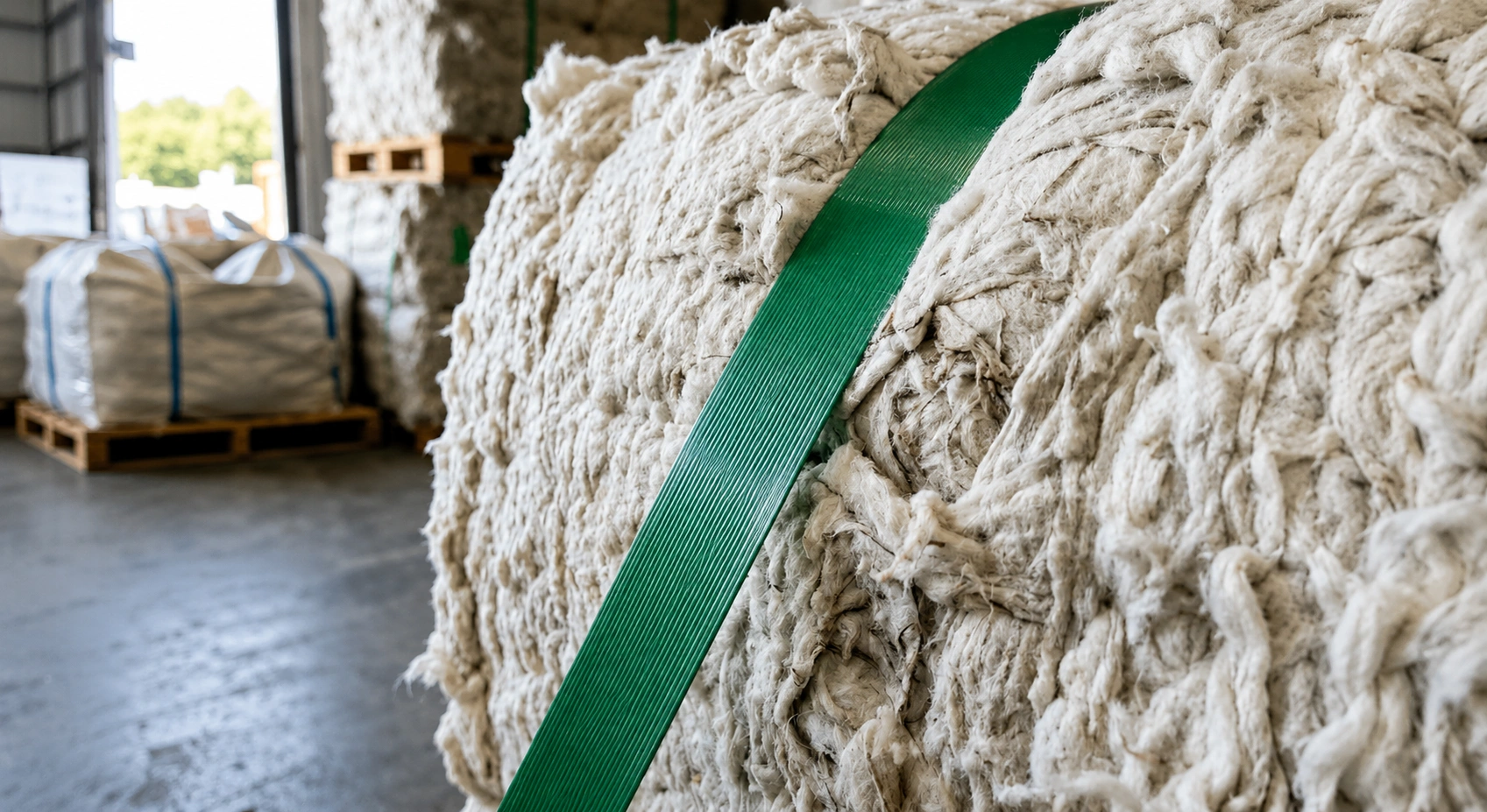
PET strapping's elasticity is exactly what a relaxing bale needs: as the fibre expands slightly, the strap stretches and recovers, keeping tension rather than going slack. This retained tension keeps the bale dense throughout storage and shipping. Compared with steel, PET adds the crucial benefit of no contamination — no rust to stain cotton or textile — plus safer handling without sharp recoil. Greenstrix supplies PET strap up to 1,400 Kgf in the widths bale presses require.
- High tension retention — keeps bales dense as fibre relaxes.
- No rust contamination — protects natural fibre quality throughout the supply chain.
- High break strength — holds the stored energy of compression.
- Safe handling — no sharp recoil like steel strapping.
3. Moisture, Dust & Contamination Control
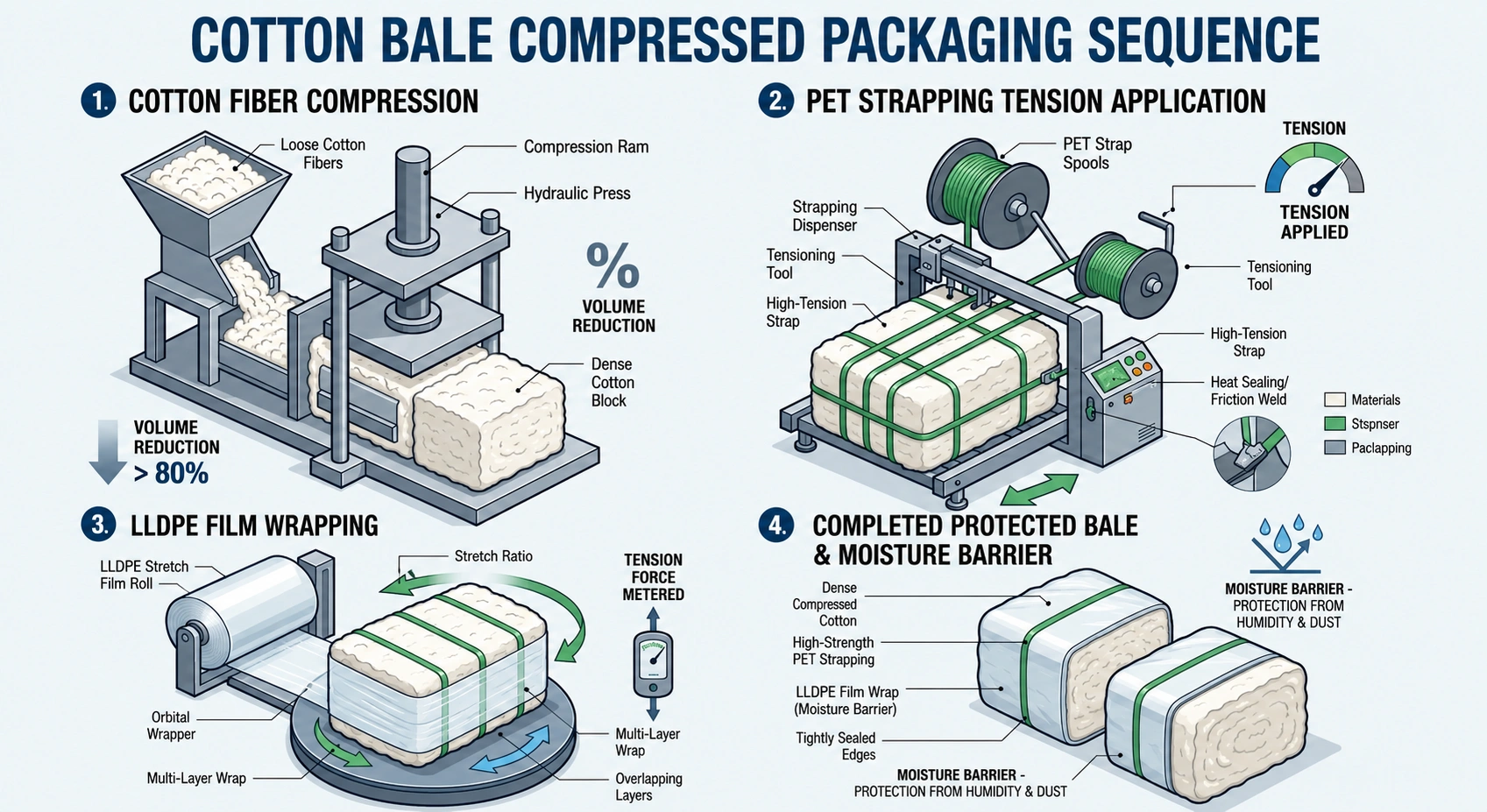
Natural fibre is hygroscopic and easily contaminated: moisture causes mould and weight-gain disputes, dust and dirt downgrade quality, and any staining is a defect. A film wrap provides a clean barrier against moisture and dust during long storage and sea transport. The strapping must be part of the contamination strategy, not a source of it. Clean PET strapping holds the bale without rust or staining, so the whole packaging system preserves fibre quality. Greenstrix supplies both the PET strap and the protective film.
4. Export Logistics & Compliance
Bales typically move long distances by sea, exposing them to weeks of humidity and handling. Packaging must keep the bale dense, dry and clean across the whole journey — retained-tension PET strapping plus a film moisture barrier achieve this where lesser packaging fails. On compliance, recyclable film and appropriate strapping support PPWR goals. Greenstrix supplies tension-retaining PET strap and recyclable film manufacturer-direct, helping European textile and cotton supply chains ship dense, clean, compliant bales.
5. Frequently Asked Questions
Q: Why does textile bale strapping lose tension?
Compressed fibre stores elastic energy and gradually relaxes, pushing outward. Strapping without good tension retention goes slack, letting the bale expand and lose density. PET strapping stretches and recovers as the bale relaxes, keeping tension live. Greenstrix supplies high-retention PET strap for bales.
Q: Can steel strapping contaminate cotton bales?
Yes — steel can rust and stain natural fibre, downgrading or ruining cotton and textile. This is a key reason PET strapping is preferred for bales: it holds high tension without any rust contamination risk. Greenstrix PET strap protects fibre quality.
Q: What break strength PET strap do textile bales need?
Compressed bales store significant energy, so high break strength is required — Greenstrix supplies PET strapping up to 1,400 Kgf in the widths bale presses use. The exact spec depends on bale size and compression; contact sales@greenstrix.com and Greenstrix can advise the right strap for your press.
Q: How do I protect bales from moisture in sea freight?
Wrap bales in stretch or shrink film to create a clean moisture and dust barrier for the long humid voyage, combined with tension-retaining PET strapping to keep the bale dense. Greenstrix supplies both the film and the strap for textile and cotton bale export.
Q: Is recyclable bale packaging available?
Yes. Greenstrix supplies recyclable LLDPE film and PPWR-aligned PET strapping, helping textile and cotton supply chains meet EU packaging-waste requirements while keeping bales dense, dry and contamination-free to destination.
We Serve Your Market
🇩🇪 Germany
- Hamburg, Bremerhaven — textile machinery & trade, high-quality bale strap
- PET Band für Textilballen — kein Rost, hohe Spannungsbeibehaltung
- Recycelbare Folie für PPWR-Konformität im deutschen Textilhandel
- Kontakt: +49 176 85614141
🇬🇧 United Kingdom
- Felixstowe, Southampton — textile import/re-export, contamination-free strap
- PET strapping prevents rust staining on UK cotton and textile imports
- PPWR recyclable film documentation for UK buyers
- Contact: sales@greenstrix.com
🇮🇹 Italy
- Genova, La Spezia — textile manufacturing hub, high bale volume
- Reggia PET per balle tessili — alta ritenzione di tensione, senza ruggine
- Film protettivo per balle di cotone in transito marittimo
- Contatto: sales@greenstrix.com
🇫🇷 France
- Le Havre, Marseille — fashion & textile, quality fibre protection
- Feuillard PET pour balles textiles — sans rouille, haute rétention
- Film recyclable PPWR-conforme pour exportateurs de fibres
- Contact: +49 176 85614141
🇵🇱 Poland
- Gdańsk, Gdynia — growing textile sector, cost-effective PET strap
- Taśma PET do bel bawełny — brak korozji, wysoka retencja naprężeń
- Folia ochronna przed wilgocią w transporcie morskim
- Kontakt: sales@greenstrix.com
🇳🇱 Netherlands
- Rotterdam — fibre re-export hub, bale moisture protection
- PET strap and film for Dutch textile and cotton re-export bales
- PPWR recyclability documentation available
- Contact: sales@greenstrix.com
🇪🇸 Spain
- Valencia, Algeciras — textile & cotton trade, sea-freight bale strap
- Fleje PET para balas de algodón — sin óxido, alta retención
- Film protector de humedad para exportaciones marítimas
- Contacto: +49 176 85614141
🇧🇪 Belgium
- Antwerp — textile distribution, clean bale securing
- PET strap and film for Belgian textile and cotton distribution
- PPWR compliance documentation available
- Contact: sales@greenstrix.com
🇦🇹 Austria
- via Hamburg — technical textiles, precision baling
- PET Band für österreichische technische Textilindustrie
- Feuchtigkeitsschutz-Folie für Langstreckentransporte
- Kontakt: +49 176 85614141
🇸🇪 Sweden
- Gothenburg — textile recycling sector, recyclable bale packaging
- Recyclable PET strap and LLDPE film for Swedish textile recycling
- PPWR-aligned packaging for circular textile supply chains
- Contact: sales@greenstrix.com
Strap textile & cotton bales dense and contamination-free. Email sales@greenstrix.com or WhatsApp +49 176 85614141. Share bale dimensions, compression level and destination port. Replies within one business day.