📋 Quick Facts: Reduce Packaging Costs Europe 2026
- Strategy: 7 proven cost reduction approaches
- Typical Savings: 20–40% over 12–24 months
- Biggest Win: Annual supply contract vs spot: 15–25% unit cost reduction
- Film Savings: Stretch film downgauging: 15–25% material reduction
- Strap Savings: Steel to PET switch: 30–40% TCO reduction
- TCO Tool: Greenstrix TCO worksheet available on request
- Markets: DE · UK · IT · FR · PL
- Contact: +49 176 85614141
- Email: sales@greenstrix.com
- Response: 1 business day
Industry Research: A 2025 survey of European manufacturing procurement managers found that 73% focus exclusively on unit price when purchasing packaging materials — missing the 40-60% of total packaging cost that lies in machine compatibility, damage rates, labor efficiency, and regulatory compliance.
The packaging budget is one of the most consistently mismanaged cost lines in European manufacturing and logistics operations. It is also one of the most correctable. The gap between what most operations pay for industrial packaging and what they should pay — given optimal material selection, specification accuracy, and supply strategy — is typically 20–40% of total packaging cost.
This guide is for procurement managers and supply chain directors who want to eliminate that gap. It covers seven proven strategies, a structured audit methodology, and the benchmarking data needed to identify exactly where your operation's cost improvement opportunities lie.
Quick Answers for European Buyers
How can I reduce industrial packaging costs in Europe?
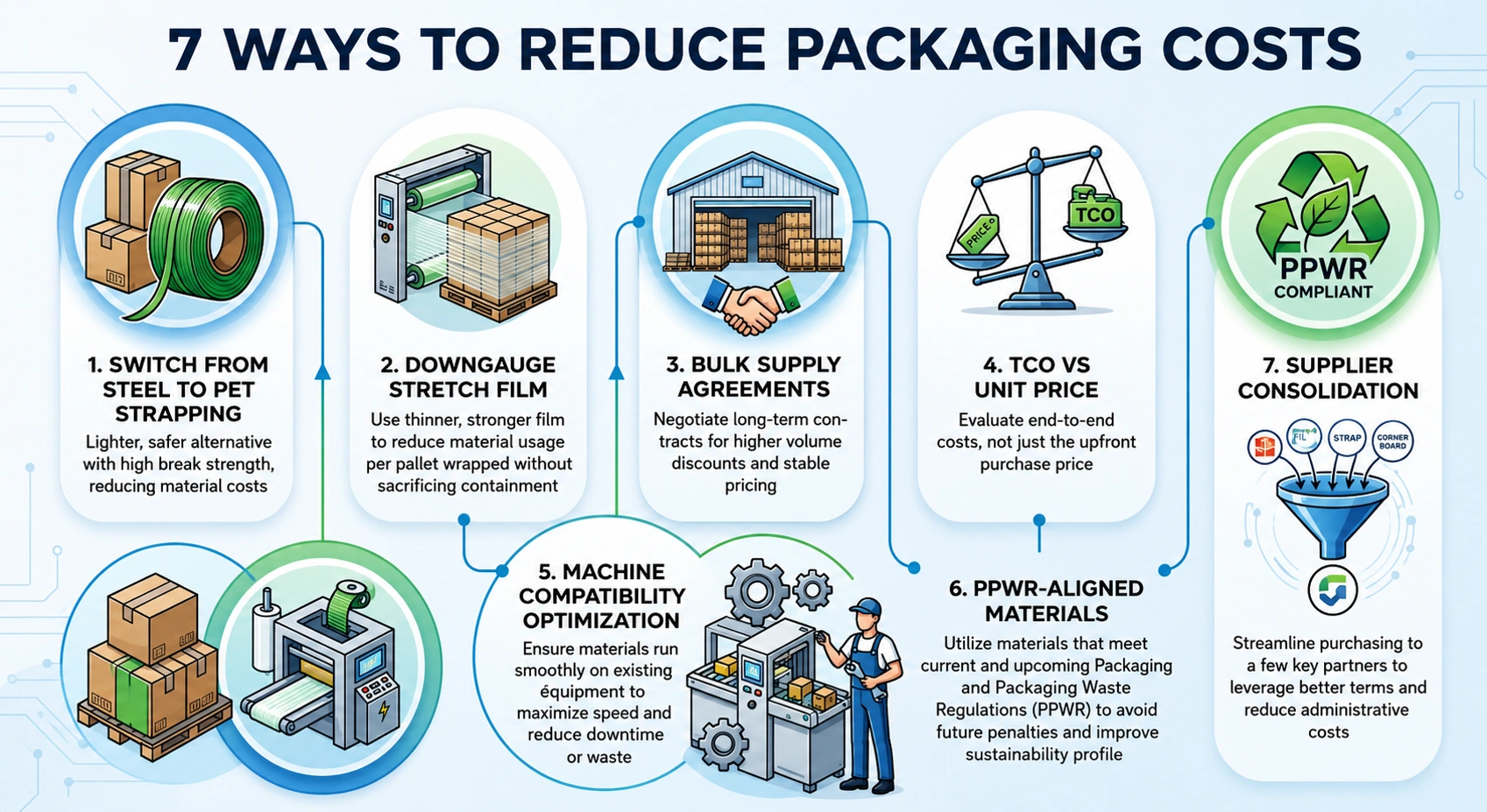
7 proven strategies: (1) Switch steel strapping to PET — 30–40% TCO reduction. (2) Downgauge stretch film — 15–25% material savings. (3) Consolidate to one qualified supplier — 8–12% volume savings. (4) Annual supply contract vs spot — 15–25% unit cost reduction. (5) Machine-material compatibility audit — reduce downtime. (6) PPWR-align materials now. (7) Switch to cord strap for heavy cargo — eliminates injury and damage costs.
What is packaging TCO analysis?
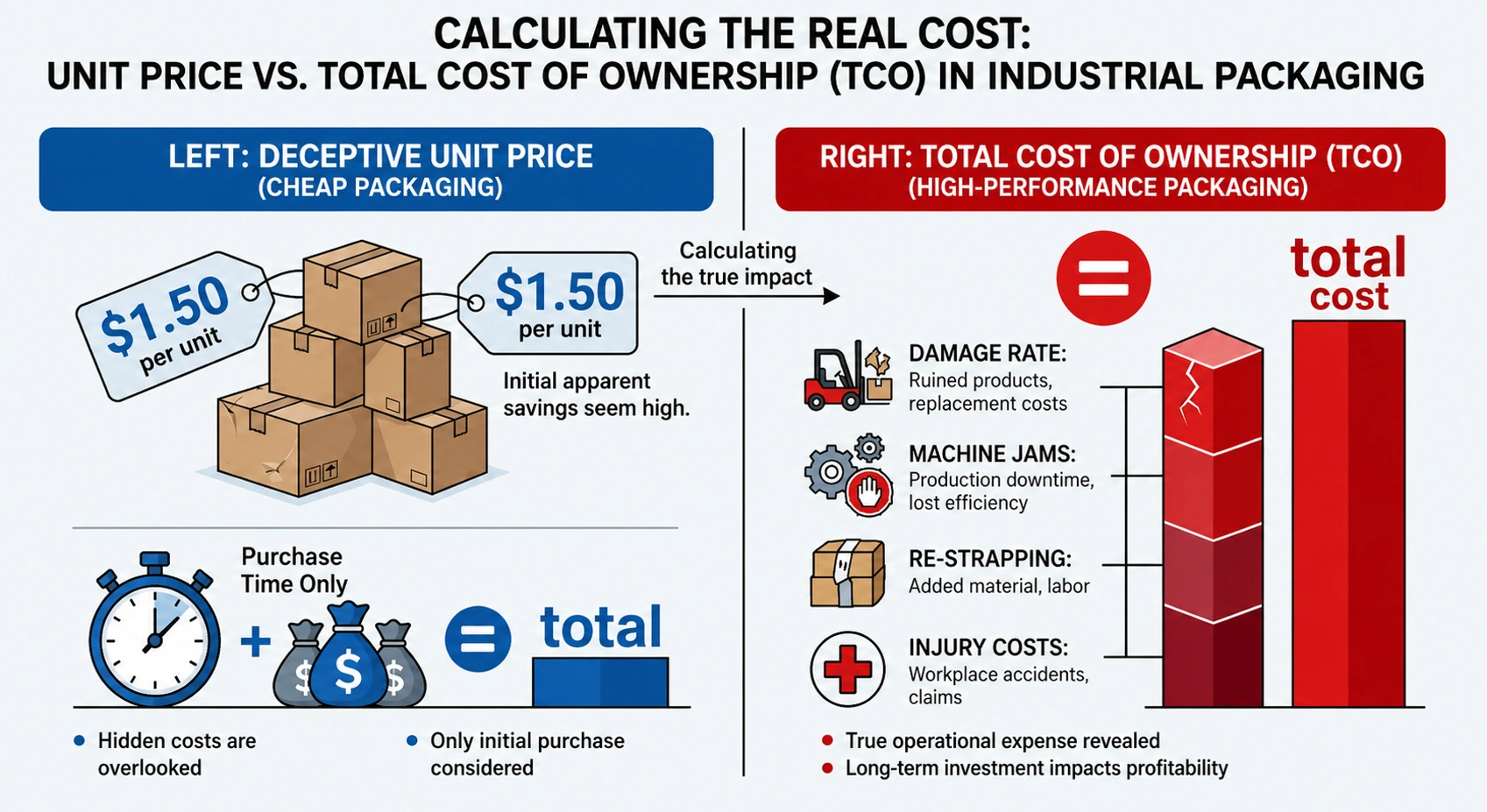
Total Cost of Ownership (TCO) = material cost + machine downtime cost + re-strapping labor + transit damage cost + regulatory compliance cost. Most packaging procurement decisions miss 40–60% of the true cost by focusing only on unit price. Greenstrix provides a free TCO worksheet — email sales@greenstrix.com.
1. Why Unit Price Is the Wrong Metric
The single most damaging procurement practice in industrial packaging is optimizing for unit price rather than Total Cost of Ownership (TCO). A packaging material that costs 5% less per unit but causes 3× more machine jams, generates 2× the transit damage claims, and creates PPWR compliance documentation costs is dramatically more expensive in real terms — it just does not appear that way on a purchase order comparison.
| Cost Element | Unit Price View | TCO View |
|---|---|---|
| Material cost | ✅ Captured | ✅ Captured |
| Machine downtime (jams) | ❌ Invisible | ✅ Quantified |
| Re-strapping labor | ❌ Invisible | ✅ Quantified |
| Transit damage claims | ❌ Invisible | ✅ Quantified |
| Labor efficiency per pallet | ❌ Invisible | ✅ Quantified |
| Injury liability (sharp edges) | ❌ Invisible | ✅ Quantified |
| Regulatory compliance cost | ❌ Invisible | ✅ Quantified |
European operations that switch from unit price to TCO as their primary procurement metric consistently report 20–40% reduction in total packaging cost — not through paying less for individual items, but through eliminating the hidden costs that commodity materials generate.
2. The 7 Proven Strategies
Strategy 1: Switch from Steel to PET Strapping
Steel strapping costs less per coil than PET strapping in unit terms. In TCO terms, it is almost always more expensive. The hidden costs of steel strapping include: worker injury liability (12,000+ EU reportable injuries annually), cargo rust staining and abrasion damage, inability to re-tension after load settling (requiring destination rewrapping), and PPWR compliance documentation complexity. For heavy industrial pallets currently strapped with steel, switching to PET strapping typically delivers 15–25% reduction in total strapping cost when all factors are included.
Strategy 2: Downgauge Your Stretch Film
The majority of European operations are using stretch film that is 2–5 microns thicker than their load profile requires. This is not a safety margin — it is waste. A systematic downgauging review, matching film micron to actual load weight and transit distance, typically reduces stretch film material consumption by 15–25% with zero change to load containment performance. At the European scale — 1.2 million tonnes of stretch film consumed annually — the cost savings across the market are enormous. For individual operations, a downgauging review typically takes 2–4 weeks and pays back the review cost within the first month of implementation.
Strategy 3: Consolidate to One Qualified Packaging Supplier
Operations using three, four, or five different packaging suppliers for strapping, film, and hardware are paying a significant fragmentation premium. Each supplier relationship requires separate qualification, separate documentation management, separate quality monitoring, and separate commercial negotiation — all of which consume procurement bandwidth and generate coordination costs. Consolidating to a single qualified supplier for all packaging materials typically delivers 8–12% unit cost reduction through volume leverage, plus significant reduction in procurement management cost. Greenstrix supplies PET strapping, PP strapping, stretch film, shrink film, cord strap, and GI wire buckles from a single point of supply.
Strategy 4: Negotiate Annual Supply Agreements
Spot purchasing is the highest-cost procurement strategy for high-volume consumables. Suppliers price spot orders at a premium to reflect the lack of volume commitment. Annual supply agreements — specifying annual volume, monthly delivery schedule, and quality standards — typically command 15–25% unit price reduction versus equivalent spot pricing. They also eliminate supply risk (your allocation is secured) and reduce procurement administration cost. For packaging materials consuming more than €50,000 per year, an annual supply agreement is almost always the right structure.
Strategy 5: Optimize Machine-Material Compatibility
Strapping and film machines are designed to operate within specific material tolerance bands. When the material supplied falls outside those bands — wrong core diameter, dimensional variation beyond machine tolerance, incorrect surface finish — the machine compensates through operator intervention, recalibration, or simply tolerates poor performance. A machine-material compatibility audit — running sample materials through each machine with a technician present — frequently identifies mismatches that, when corrected, reduce machine downtime by 30–60% and eliminate chronic jam patterns. This is a one-time investment that pays back in weeks.
Strategy 6: Align Materials with PPWR Requirements
The EU PPWR is creating a bifurcated packaging market: compliant materials that qualify for European tenders and supply chains, and non-compliant materials that are progressively excluded. Operations that source packaging from non-compliant suppliers today are building a compliance liability that will require costly remediation as PPWR enforcement intensifies. Proactively aligning to PPWR-compliant materials from qualified suppliers — obtaining Declarations of Conformity now — positions your operation for compliant tendering and eliminates future switching costs.
Strategy 7: Switch to Composite Cord Strap for Heavy Cargo
Operations using steel strapping for heavy cargo securing are paying a premium in hidden costs: injury liability, rust damage claims, destination rewrapping, and manual handling compliance costs. Composite cord strap is 80% lighter, re-tensionable during transit, eliminates snap-back injury risk, and is fully PPWR recyclable. For operations securing cargo above 500 Kgf, the switch from steel to cord strap typically delivers positive ROI within the first year when injury costs, damage claims, and labor savings are included.
3. Packaging Cost Benchmarking
| KPI | Best Practice | European Average | Improvement Opportunity |
|---|---|---|---|
| Re-strapping rate | <0.5% | 3–8% | High — material or machine issue |
| Machine jam frequency | <1 per 500 straps | 1 per 50–200 straps | High — material quality issue |
| Film consumption per pallet | 150–200g | 250–350g | High — downgauging opportunity |
| Supplier count (strapping + film) | 1–2 qualified | 3–6 fragmented | Medium — consolidation opportunity |
| Supply contract type | Annual agreement | Mix of spot and contract | High — 15–25% unit cost reduction |
| PPWR compliance documentation | Full DoC on file | Partial or none | Critical — compliance risk |
| Transit damage rate (packaging-related) | <0.2% | 0.8–2.5% | High — material specification issue |
4. Step-by-Step: How to Conduct a Packaging Cost Reduction Audit
- Collect baseline data: Gather current material costs per pallet/unit, machine utilization rates, damage claim rates, and re-strapping frequency. This establishes the baseline from which savings will be measured.
- Map material specifications against load requirements: Verify whether you are overspecified (costing extra) or underspecified (causing damage) for each load type. Both errors are common and both are correctable.
- Request TCO comparison quotes from qualified suppliers: Specify annual volume and ask for pricing including all logistics costs to your warehouse. A true TCO comparison requires delivered pricing, not ex-works.
- Conduct machine-material compatibility audit: Run sample rolls through each machine with a technician present. Document jam rates, tension consistency, and seal quality. Identify whether machine settings need adjustment or materials need to change.
- Verify PPWR recyclability status for all current materials: Request Declarations of Conformity from all current suppliers. If a supplier cannot provide PPWR recyclability documentation, that is a compliance risk you must plan to resolve.
- Calculate total annual savings from each strategy: Prioritize changes by ROI and implementation speed. Annual supply contract renegotiation and material switches typically yield the fastest returns with minimal disruption.
- Implement with supplier agreements and performance KPIs: Document quality specifications, delivery schedules, and measurable performance targets in supplier agreements. Review KPIs quarterly in the first year.

5. Related Guides
- EU PPWR 2025/2026: Complete Guide for European Packaging Buyers
- PET vs PP vs Cord Strap: Definitive Selection Guide
- PET Strapping Band — Complete Technical Guide
- LLDPE Stretch Film — Complete Technical Guide
- Composite Cord Strap — Complete Engineering Evidence
We Serve Your Market
🇩🇪 Germany
- Deutsche Industrieunternehmen sparen 20–40% Verpackungskosten durch Optimierung
- Jahresvertrag mit Greenstrix: 15–25% Preisreduzierung gegenüber Spotmarkt
- VDI 2700 konforme Materialien inklusive — kein separates Compliance-Budget
- Greenstrix Europa-Kontakt: +49 176 85614141 (Deutsch/Englisch)
🇬🇧 United Kingdom
- UK industrial buyers save 20–40% on packaging costs through strategic procurement
- Annual supply contract with Greenstrix: 15–25% unit cost reduction vs spot
- PPWR-compliant materials included — no separate compliance cost
- Europe contact: +49 176 85614141
🇮🇹 Italy
- Le aziende italiane risparmiano 20–40% sui costi di imballaggio
- Contratto annuale con Greenstrix: riduzione costi 15–25%
- Materiali conformi PPWR inclusi — nessun costo di conformità separato
- Contatto: sales@greenstrix.com
🇫🇷 France
- Les entreprises françaises économisent 20–40% sur les coûts d'emballage
- Contrat annuel avec Greenstrix: réduction coûts 15–25%
- Matériaux conformes PPWR inclus
- Contact: +49 176 85614141
🇵🇱 Poland
- Polskie firmy oszczędzają 20–40% na kosztach opakowań
- Roczna umowa z Greenstrix: redukcja kosztów 15–25%
- Materiały zgodne z PPWR w cenie
- Kontakt: sales@greenstrix.com
Request a free packaging TCO analysis for your operation. Contact Greenstrix at sales@greenstrix.com or WhatsApp our European team at +49 176 85614141. Share your current materials, volumes, and machine types. We will provide a structured TCO comparison and cost reduction proposal within 48 hours.