📋 Quick Facts: PET vs PP vs Cord Strap
- PP Strapping: Best for cartons, FMCG, e-commerce — under 200 Kgf/strap
- PET Strapping: Best for heavy pallets, metals, industrial — 200–1,400 Kgf/strap
- Cord Strap: Best for machinery, glass, sea freight — over 500 Kgf, steel replacement
- Decision Rule: Load weight + application + machine type = correct choice
- All PPWR Compliant: PET · PP · Cord Strap — all recyclable, all PPWR ready
- All from Greenstrix: One supplier for all three — +49 176 85614141
- MOQ: 1 pallet per product for trial orders
- Response: 1 business day
The Decision That Matters: Choosing the wrong strapping material costs European industrial operations an average of 8–15% more in total packaging cost than the correct material — through machine jams, transit damage, re-strapping labor, and injury liability.
Strapping material selection is the most consequential specification decision in industrial packaging. Choose correctly and your operation runs at optimal cost, safety, and compliance. Choose incorrectly and you pay the difference every day in machine downtime, damage claims, re-strapping labor, and injury incidents. This guide provides the definitive technical and commercial framework for European industrial buyers to make the right choice — every time.
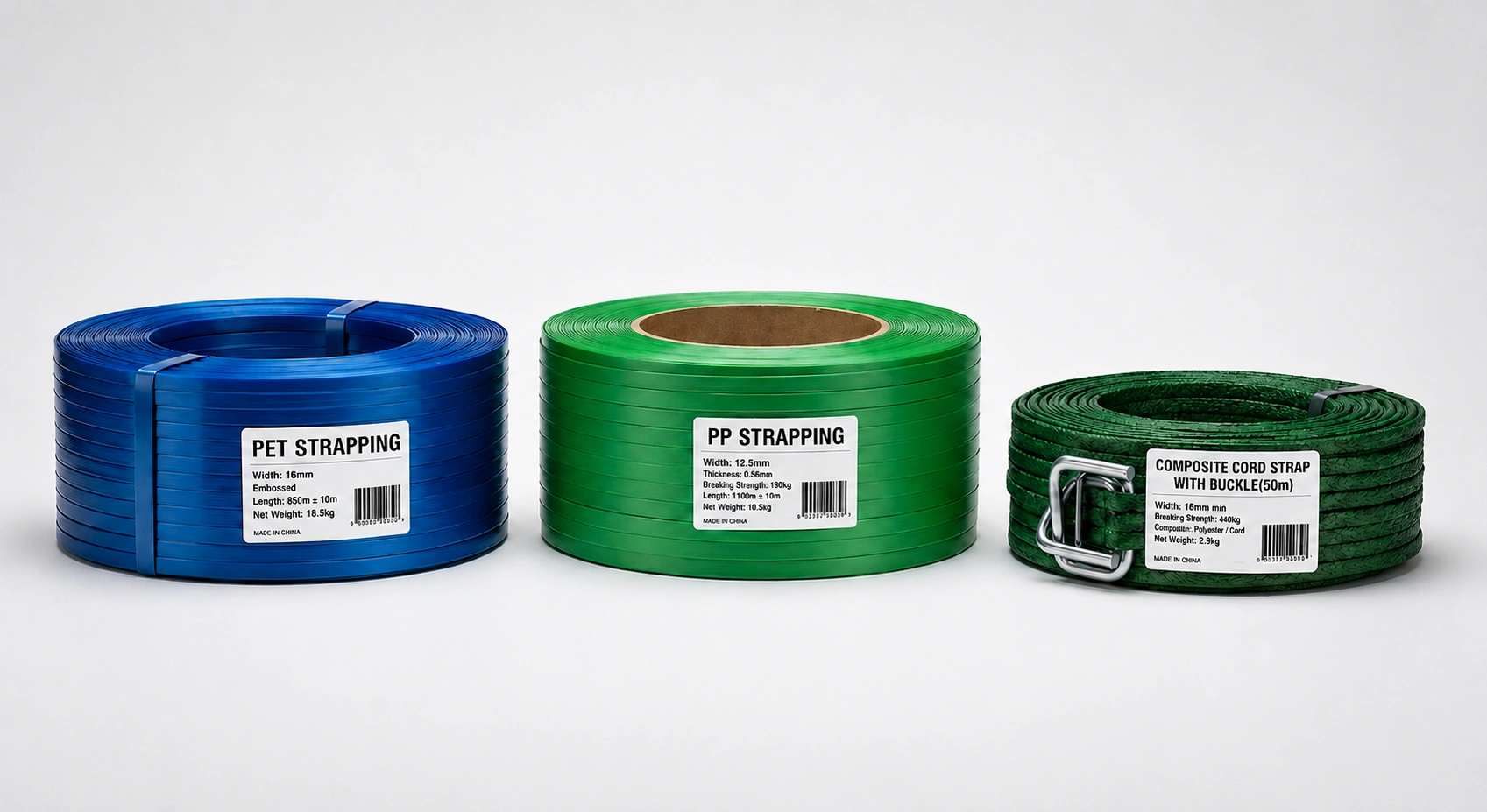
Quick Answers for European Buyers
What is the difference between PET and PP strapping?
PP strapping: polypropylene, 5–18mm, 38–188 Kgf, for cartons/FMCG/e-commerce under 200 Kgf per strap. PET strapping: polyester, 12–32mm, 186–1,400 Kgf, for heavy pallets/metals/industrial loads. PP is cheaper and faster; PET is stronger with better elastic recovery. Both from Greenstrix: +49 176 85614141.
When should I use composite cord strap instead of PET?
Use cord strap when: load exceeds 1,000 Kgf, currently using steel strapping, cargo is high-value/surface-sensitive (machinery, glass), shipment is sea freight, or re-tensioning during transit is needed. Cord strap is DNV certified, EN 12195-2 compliant, and available from Greenstrix to 2,680 Kgf system strength.
Which strapping is best for sea freight to Europe?
For pallets under 500 Kgf: PET strapping 25mm+ with elastic recovery. For heavy machinery/industrial cargo: composite cord strap HD 25–32mm with GI wire buckles (500-hour salt spray certified). For lightweight cartons: PP strapping on standard pallet. All from Greenstrix — contact: sales@greenstrix.com.
1. The 30-Second Answer
| Load Weight per Strap Point | Recommended Material | Key Reason |
|---|---|---|
| Under 200 Kgf | PP Strapping | Lowest cost, highest machine speed, adequate strength for light loads |
| 200 – 1,400 Kgf | PET Strapping | Superior strength, elastic recovery, machine compatibility, TCO |
| Over 500 Kgf or replacing steel | Composite Cord Strap | Maximum strength, re-tensionable, safest, DNV certified |
The ranges above overlap intentionally — the 500–1,400 Kgf range is where both PET strapping and cord strap are technically viable. In this range, the decision depends on secondary factors: machine availability, re-tensionability requirement, surface safety priority, and whether DNV certification is required. The sections below provide the detail needed to make the right call in every case.
2. The Definitive Comparison Table
| Property | PP Strapping | PET Strapping | Composite Cord Strap |
|---|---|---|---|
| Material | Polypropylene | Polyethylene Terephthalate | High-Tenacity Polyester Fiber |
| Break Strength Range | 38 – 188 Kgf | 186 – 1,400 Kgf | 200 – 1,450 Kgf (2,680 Kgf system) |
| Width Range | 5 – 18mm | 12 – 32mm | 13 – 32mm |
| Elongation at Break | 10 – 25% | 8 – 20% | 3 – 7% |
| Elastic Recovery | Low – Moderate | ≥85% at 4% elongation | Low — load holding, not dynamic |
| Machine Speed | Up to 60/min | Up to 40/min | Manual / buckle application |
| Sharp Edge Risk | None | None | None |
| Rust Risk | None | None | None |
| Re-Tensionable | No | No | Yes ✅ |
| Cost Per Strap | Lowest | Moderate | Highest (lowest TCO for heavy cargo) |
| Temperature Range | -10°C to +50°C | -30°C to +70°C | -40°C to +80°C |
| DNV Certification | Not applicable | Not applicable | ✅ Available (Greenstrix) |
| PPWR Recyclable | ✅ PP stream | ✅ PET stream | ✅ Polyester fiber recovery |
| Best For | Cartons, FMCG, light pallets | Heavy pallets, metals, multi-modal | Heavy cargo, steel replacement, marine |
3. PP Strapping — When to Use It
PP (Polypropylene) strapping is the world's highest-volume strapping material. It is the correct choice for light-to-medium load applications where machine speed and cost per strap are the primary drivers.
Optimal applications for PP strapping:
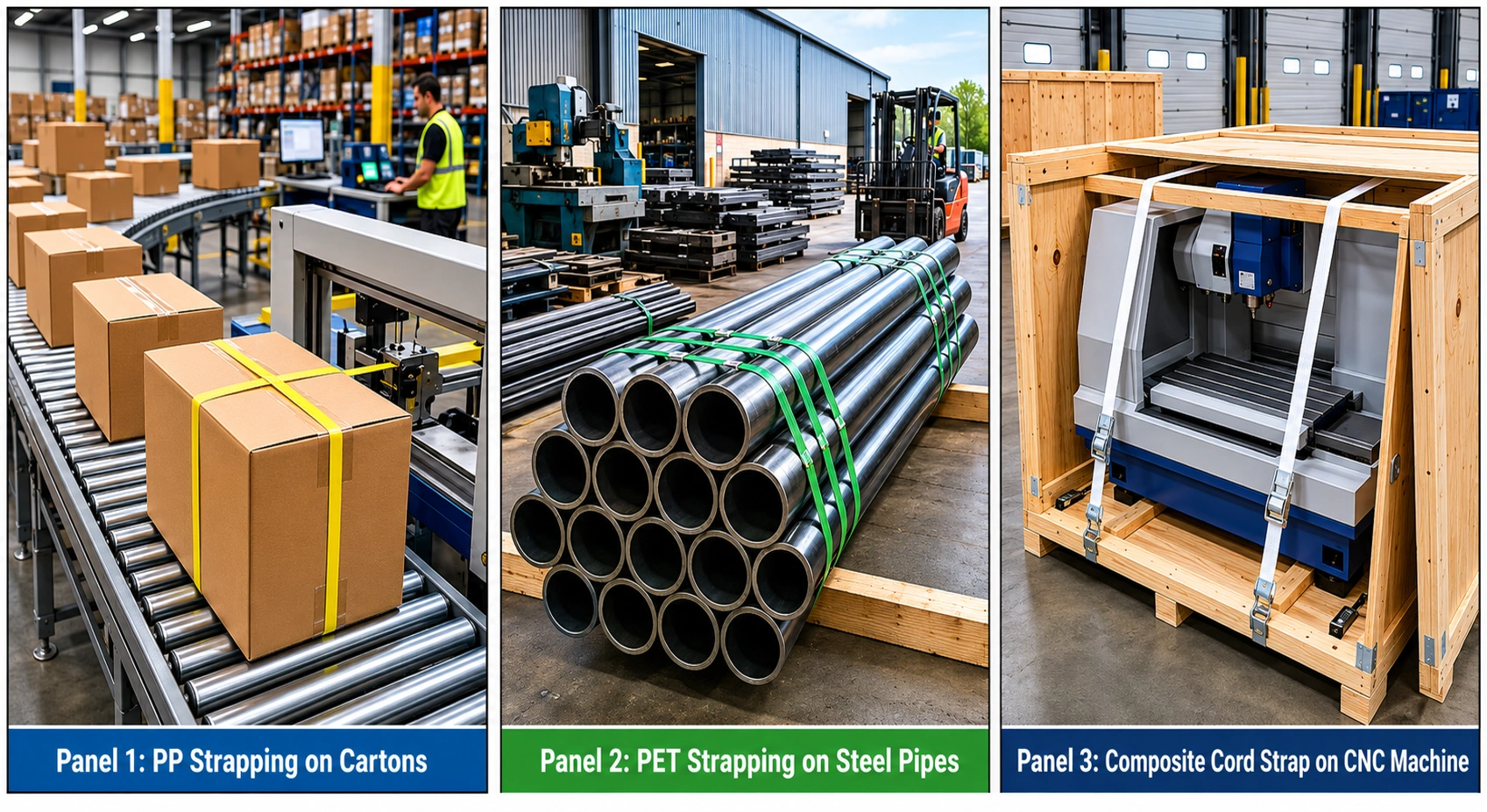
- Carton sealing and bundling on high-speed production lines (up to 60 straps/min)
- E-commerce and parcel distribution — light loads under 50 Kgf
- FMCG multi-pack bundling — beverages, food, consumer goods
- Textile and apparel export cartons — light, surface-sensitive loads
- Newspaper and magazine bundles — where marking must be minimized
- Any application under 200 Kgf per strap point in a controlled indoor environment
When NOT to use PP strapping: Heavy pallets above 200 Kgf per strap point, outdoor or cold chain applications below -10°C, extended UV exposure, multi-modal transit requiring dynamic load retention, or any application where strap failure would create a safety hazard.
Full technical guide: PP Strapping Band — Complete Technical Guide for European Production Line Managers
4. PET Strapping — When to Use It
PET (Polyethylene Terephthalate) strapping is the professional standard for heavy industrial packaging across European logistics. Its combination of high break strength, excellent elastic recovery, and machine compatibility makes it the optimal choice for the majority of heavy-duty applications.
Optimal applications for PET strapping:
- Heavy industrial pallets — construction materials, metals, machinery components
- Metal coils, pipes, and extrusions — 19–32mm, 500–1,400 Kgf
- Cotton and fiber bales — compression retention and recovery
- Multi-modal transit (road + sea + rail) — elastic recovery maintains tension through load settling
- Cold chain logistics — rated to -30°C
- Automotive parts and components — surface-safe, no rust contamination
When NOT to use PET strapping: Light carton sealing applications where PP is more cost-effective, applications above 1,400 Kgf requiring DNV certification, or applications requiring re-tensionability during transit.
Full technical guide: PET Strapping Band — Complete Technical Guide for European Industry
5. Composite Cord Strap — When to Use It
Composite cord strap is the direct modern replacement for steel strapping and the highest-performance strapping solution for heavy cargo securing. It is the only strapping material that can be re-tensioned after application — a critical capability for sea freight and multi-modal transit where load settling is unavoidable.
Optimal applications for composite cord strap:
- Direct replacement for steel strapping — eliminates snap-back injury risk and rust staining
- Heavy machinery and capital equipment (CNC machines, generators, turbines)
- Sea freight and international container lashing — DNV certified system strength up to 2,680 Kgf
- Out-of-gauge (OOG) and project cargo
- Glass panels, marble slabs, and surface-sensitive heavy cargo
- Cylindrical cargo (twisted variant) — pipe bundles, rolled materials
- Any application requiring re-tensioning during transit
- Safety-critical applications requiring documented lashing system strength
Full technical guide: Composite Cord Strap vs Steel — Complete Engineering Evidence
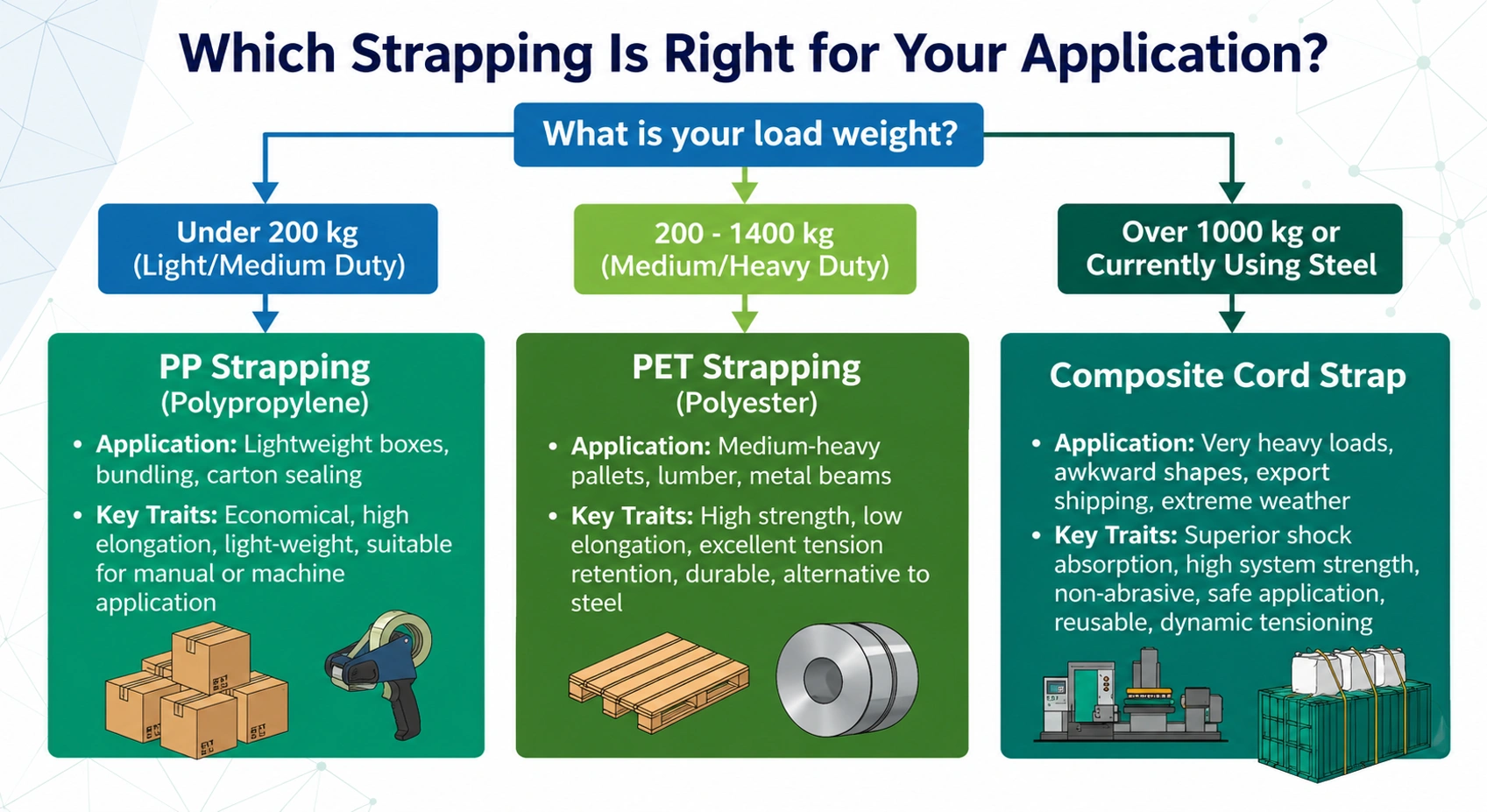
6. The Decision Flowchart — 5 Questions
- What is the load weight per strap point? — If under 200 Kgf: PP. If 200–1,400 Kgf: PET. If over 1,000 Kgf or replacing steel: Cord Strap.
- Is re-tensionability required during transit? — If yes: Cord Strap only. PP and PET cannot be re-tensioned after application.
- Is DNV certification required (sea freight)? — If yes: Cord Strap (Greenstrix DNV certified). PET and PP are not DNV certified for maritime lashing.
- Is this a high-speed automated machine application? — If yes and load is under 200 Kgf: PP. If yes and load is 200–1,400 Kgf: PET. Cord Strap is not machine-applied.
- Is the operating temperature below -10°C? — If yes: PET (rated to -30°C) or Cord Strap (rated to -40°C). PP is not recommended below -10°C.
7. Cost Comparison Per Secured Load
| Comparison Basis | PP Strapping | PET Strapping | Composite Cord Strap |
|---|---|---|---|
| Optimal load range | Under 200 Kgf | 200 – 1,400 Kgf | 500 Kgf+ / steel replacement |
| Material cost per strap | Lowest | Moderate | Highest |
| Machine downtime contribution | Low (quality grade) | Near zero (quality grade) | Near zero (manual application) |
| Transit damage liability | Low (correct spec) | Very low | Very low |
| Injury cost contribution | Zero | Zero | Zero (vs steel: high) |
| PPWR compliance cost | Low (recyclable) | Low (recyclable) | Low (recyclable) |
| Destination rewrapping need | Occasional | Rare | Near zero (re-tensionable) |
| TCO verdict | Optimal for light loads | Optimal for heavy pallets | Optimal replacing steel |
8. Related Guides
- EU PPWR 2025/2026: Complete Guide for European Packaging Buyers
- How to Reduce Industrial Packaging Costs in Europe 2026
- PET Strapping Band — Complete Technical Guide
- PP Strapping Band — Complete Technical Guide
- Composite Cord Strap — Complete Engineering Evidence
- GI Wire Buckles — Complete Technical Guide
We Serve Your Market
🇩🇪 Germany
- Deutsche Industriestandards: PET für Schwerlasten, PP für Kartons, Kordband für Maschinen
- Alle Greenstrix Produkte EN 12195-2 und PPWR konform
- Musterbestellung möglich: +49 176 85614141
- Technische Beratung auf Deutsch verfügbar
🇬🇧 United Kingdom
- UK industrial standard: PET for heavy loads, PP for cartons, cord strap for machinery
- All EN 12195-2 and PPWR compliant — full documentation available
- Sample orders: +49 176 85614141
🇮🇹 Italy
- Standard industriale italiano: PET per carichi pesanti, PP per cartoni
- Tutti conformi EN 12195-2 e PPWR
- Ordini campione: sales@greenstrix.com
🇫🇷 France
- Standard industriel français: PET charges lourdes, PP cartons
- Tous conformes EN 12195-2 et PPWR
- Commandes échantillon: +49 176 85614141
🇵🇱 Poland
- Polski standard przemysłowy: PET dla ciężkich ładunków, PP dla kartonów
- Wszystkie zgodne EN 12195-2 i PPWR
- Zamówienia próbne: sales@greenstrix.com
Not sure which strapping is right for your application? Contact Greenstrix at sales@greenstrix.com or WhatsApp our European team at +49 176 85614141. Share your load weight, dimensions, machine type, and application. We will specify the exact material, width, and grade — and provide a competitive bulk pricing proposal.