📋 Quick Facts: Composite Cord Strap
- Product: Composite Cord Strap
- Width: 13mm – 32mm
- Max System Strength: 2,680 Kgf (HD 32mm)
- Variants: Standard · Heavy-Duty · Twisted
- Temperature: -40°C to +80°C
- Certification: DNV GL certified
- MOQ: 1 pallet (90 coils)
- Lead Time: 20–28 days to Europe
- Certifications: DNV GL · EN 12195-2 · PPWR · ISO
- Contact: +49 176 85614141
Safety Data: According to the European Agency for Safety and Health at Work (EU-OSHA), lacerations and puncture wounds from steel strapping are among the top three injury types in European warehouse and logistics operations. Steel strap snap-back incidents account for an estimated 12,000 reportable injuries annually across EU member states. Composite cord strap eliminates this injury mechanism entirely — it has no snap-back characteristic. This is not a marginal safety improvement: it is the elimination of an entire injury category.
There is a material that has been standard in European heavy cargo securing for decades that causes thousands of worker injuries every year, damages cargo through rust staining and sharp-edge abrasion, cannot be re-tensioned after load settling, weighs significantly more than its modern alternative, and offers no performance advantage over that alternative in any measurable metric. That material is steel strapping.
Composite cord strap — engineered from high-tenacity polyester filaments encapsulated in a polymer coating — matches or exceeds steel strapping performance in tensile strength, while delivering categorical improvements in worker safety, cargo protection, weight reduction, and operational flexibility. The engineering evidence supporting this transition is conclusive, which is why European shipping authorities, DNV GL, and progressive logistics operations across Germany, Italy, the UK, France, and Poland have systematically specified composite cord strap for heavy cargo applications.
Quick Answers for European Buyers
What is composite cord strap?
Composite cord strap is an engineered lashing product made from high-tenacity polyester filaments encapsulated in polymer coating. It matches steel strapping in tensile strength (up to 2,680 Kgf system strength) while eliminating steel's dangers: no snap-back laceration risk, no rust staining, no sharp edges, 80% lighter. DNV GL certified and EN 12195-2 compliant. Supplied by Greenstrix to European buyers.
Who supplies composite cord strap in Europe?
Greenstrix (greenstrix.com) is a DNV GL certified supplier of composite cord strap to Germany, UK, Italy, France and Poland. Contact: sales@greenstrix.com or +49 176 85614141.
Composite cord strap vs steel strapping — which is better?
Composite cord strap is superior in every measurable metric: same or higher strength (up to 2,680 Kgf), no snap-back injuries (12,000+ EU steel strap injuries per year), no rust staining, re-tensionable in transit, 80% lighter. The EU-OSHA identifies steel strap snap-back as a top-3 European warehouse injury cause.
1. The Engineering of Composite Cord Strap
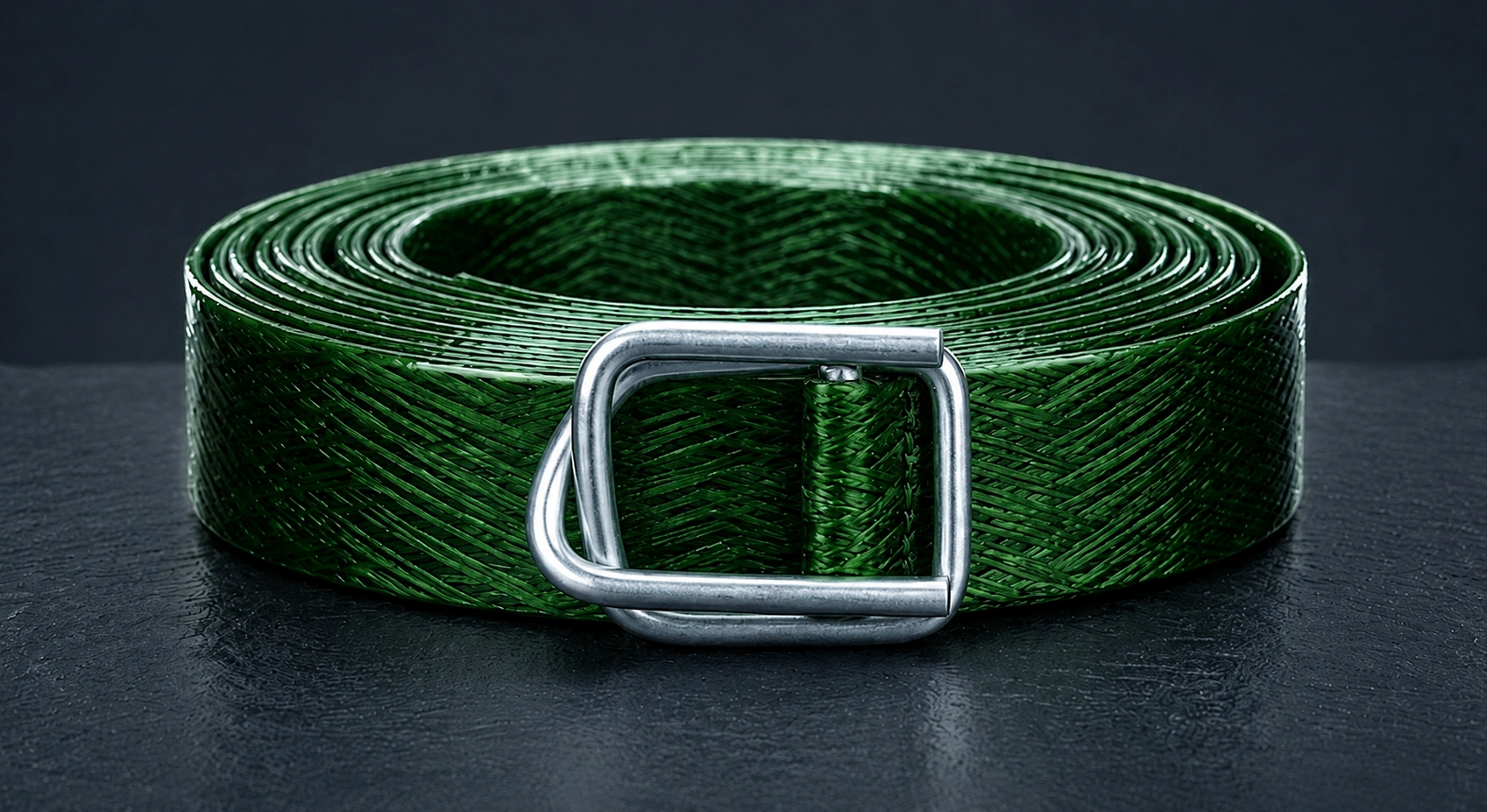
Composite cord strap is a layered engineered product. The structural core consists of hundreds of high-tenacity polyester filaments, produced by a continuous drawing process that aligns the polymer chains in the fiber direction to produce maximum tensile strength. These filaments are then encapsulated in a precision-extruded polymer coating that binds the fibers, protects against abrasion and UV degradation, provides a consistent outer surface for buckle engagement, and maintains performance across the temperature range from -40°C to +80°C.
The polymer coating is not merely a surface treatment — it is a structural element. It prevents individual fiber damage from propagating through the strap cross-section, and it provides the controlled friction characteristics that allow GI wire buckles to engage at calibrated tension without cutting the fibers. The combination of fiber composite strength and polymer engineering flexibility is what makes cord strap's performance profile categorically superior to steel.
2. Complete Performance Data — All Variants
| Product Code | Width | Break Strength | System Strength | Coil Length | Coils/Pallet |
|---|---|---|---|---|---|
| GS-CS-13 | 13mm | 200 Kgf | 370 Kgf | 1,100m | 90 |
| GS-CS-16 | 16mm | 300 Kgf | 540 Kgf | 850m | 90 |
| GS-CS-19 | 19mm | 360 Kgf | 620 Kgf | 600m | 90 |
| GS-CS-19 HD | 19mm | 450 Kgf | 820 Kgf | 600m | 90 |
| GS-CS-25 Std | 25mm | 730 Kgf | 1,350 Kgf | 500m | 90 |
| GS-CS-25 HD | 25mm | 900 Kgf | 1,660 Kgf | 500m | 90 |
| GS-CS-32 Std | 32mm | 1,250 Kgf | 2,300 Kgf | 300m | 90 |
| GS-CS-32 HD | 32mm | 1,450 Kgf | 2,680 Kgf | 300m | 90 |
| GS-CS-T-19 (Twisted) | 19mm | 340 Kgf | 600 Kgf | 600m | 90 |
| GS-CS-T-25 (Twisted) | 25mm | 680 Kgf | 1,250 Kgf | 500m | 90 |
System Strength Note: System strength is measured as the combination of strap break strength and GI Wire Buckle joint efficiency using Greenstrix matched buckles. System strength is the operationally relevant figure — it is the load that the complete lashing assembly will hold before failure. Always specify system strength, not break strength alone, when designing a lashing system.
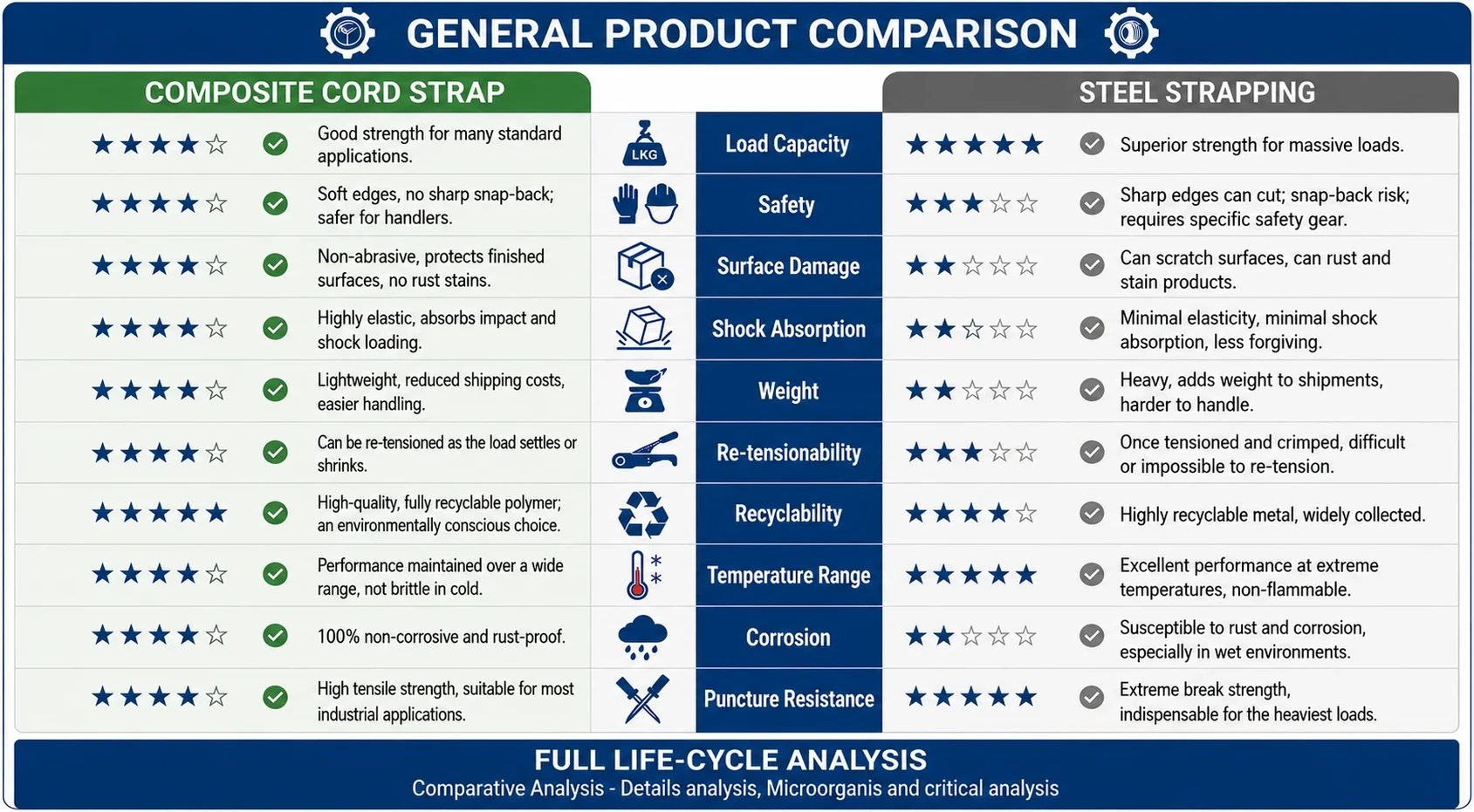
3. The Definitive Head-to-Head: Cord Strap vs Steel
| Performance Factor | Composite Cord Strap | Steel Strapping |
|---|---|---|
| Failure Mode | Progressive elongation — safe, predictable | Snap fracture — dangerous projectile |
| Sharp Edge Injury Risk | None — polymer coated, no sharp edges | Severe — lacerations and puncture risk |
| Surface Damage | None — polymer coating is surface-safe | High — rust stains, abrasion scratches |
| Shock Absorption | High — polyester elasticity absorbs impacts | None — rigid, stores then releases energy |
| Re-Tensionability | Yes — re-tension at any point in transit | No — one-time installation only |
| Weight | ~80% lighter than equivalent steel | Heavy — handling risk per manual handling regs |
| Corrosion Resistance | Full polymer protection, -40°C to +80°C | Zinc coating degrades in marine environments |
| Recyclability | Yes — polyester fiber recovery | Yes — steel scrap recovery |
| DNV Certification | ✓ Available (Greenstrix) | Varies by manufacturer |
| EU-OSHA Injury Data | Near zero snap-back incidents | 12,000+ reportable injuries/year (EU) |
Regulatory Trend: Germany's BG RCI (trade association for raw materials and chemical industry) and the UK's Health and Safety Executive have both published guidance specifically recommending composite cord strap over steel strapping for heavy cargo applications where workers are present during application and removal. Progressive European operations are switching not from choice but from obligation.
4. Three Variants for Every Application
4.1 Standard Composite Cord Strap
The Standard variant (GS-CS series) is the workhorse of the Greenstrix cord strap range. Available in 13mm through 32mm, it covers the majority of industrial lashing applications from light bundling (370 Kgf system) to heavy machinery (2,300 Kgf system). The standard variant is appropriate for all general industrial cargo types including machinery, equipment, timber, steel products, and containerized project cargo.
4.2 Heavy-Duty Composite Cord Strap
The Heavy-Duty variant (GS-CS-HD series) uses a higher filament count per unit width to achieve 25–30% higher break strength than the standard at equivalent dimensions. The 32mm HD variant achieves 2,680 Kgf system strength — the highest available in the Greenstrix range and suitable for the most demanding project cargo, OOG (Out of Gauge) shipping, and heavy capital equipment lashing applications.
4.3 Twisted Composite Cord Strap
The Twisted variant (GS-CS-T series) is engineered for applications where the strap must wrap around cylindrical, conical, or irregular-profile cargo — pipe bundles, rolled materials, turbine components, or any load where standard flat strap would kink at the contact radius. The twisted construction distributes contact stress uniformly around the bend, maintaining full strap strength through the curve. Available in 19mm and 25mm widths.
5. Application Guide by Cargo Type
| Cargo Type | Recommended Variant | Width | System Strength |
|---|---|---|---|
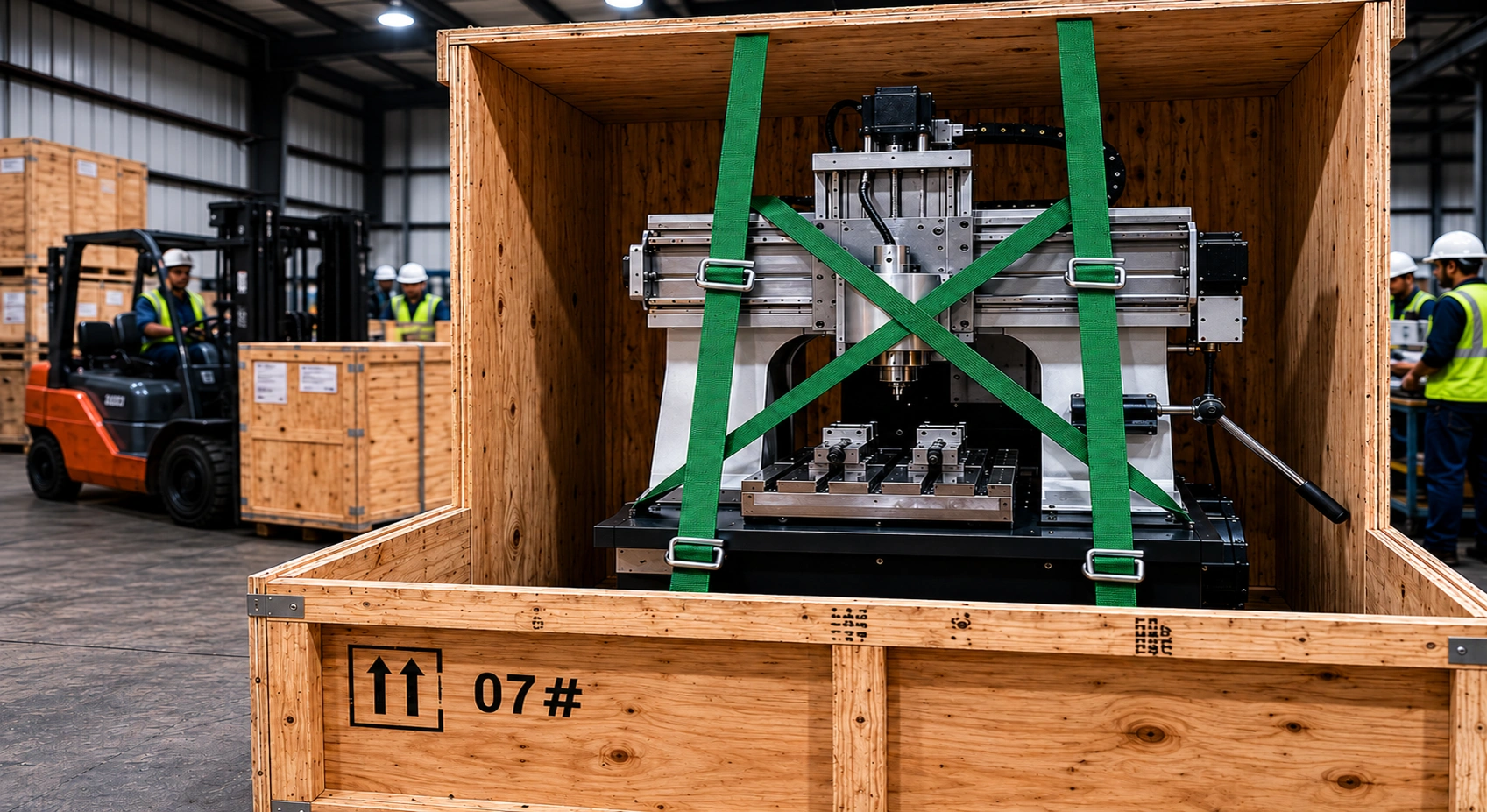
| Heavy machinery (CNC, generators) | Heavy-Duty | 32mm | 2,680 Kgf |
| Steel coils and pipes | Standard | 25mm – 32mm | 1,350 – 2,300 Kgf |
| Glass panels, marble slabs | Standard | 19mm – 25mm | 620 – 1,350 Kgf |
| Timber bundles | Standard | 19mm – 25mm | 620 – 1,350 Kgf |
| Project cargo (OOG) | Heavy-Duty | 32mm | 2,680 Kgf |
| Cylindrical cargo | Twisted | 19mm – 25mm | 600 – 1,250 Kgf |
| Container lashing | Standard or HD | 25mm – 32mm | 1,350 – 2,680 Kgf |
| Light industrial bundling | Standard | 13mm – 16mm | 370 – 540 Kgf |
6. DNV GL Certification and EN 12195 Compliance
Greenstrix composite cord strap is produced under DNV GL certified quality management processes. DNV GL (Det Norske Veritas and Germanischer Lloyd) is the world's leading independent maritime classification and technical assurance organization. DNV GL certification of a cargo securing product is the highest available independent quality endorsement for maritime applications.
For road transport, the EN 12195 standard for load restraint assemblies applies. Greenstrix cord strap systems meet the EN 12195 protocol for lashing assemblies: rated at 1.5× working load limit with no deformation after three test cycles at rated load, and with clearly documented system strength ratings for each strap width and buckle combination.
7. Frequently Asked Questions
Q: What is the correct number of straps for a given cargo weight?
The calculation follows EN 12195 principles: total lashing force must equal or exceed the cargo weight multiplied by the relevant deceleration factor (typically 0.8g for road, 1.0g for sea freight). Divide the required total force by the system strength per strap to determine minimum strap count. Greenstrix provides a lashing calculation worksheet — contact sales@greenstrix.com to request it. Always add at least one additional strap as a safety redundancy.
Q: Can composite cord strap be used in outdoor storage before shipping?
Yes. The polymer coating provides full UV stability and weather resistance across the temperature range -40°C to +80°C. For extended outdoor storage (more than 6 months), inspect the polymer surface before use — any cracking or surface degradation should be investigated. Standard outdoor storage conditions in European climate zones present no performance risk for Greenstrix cord strap.
Q: What is the maximum temperature for composite cord strap in transit?
Greenstrix composite cord strap is rated to +80°C, which covers all standard logistics environments including heated containers. For applications involving direct heat exposure above 70°C (e.g., proximity to industrial heat sources), consult Greenstrix for guidance on specialized high-temperature lashing solutions.
Q: How is composite cord strap cut in the field?
Cord strap can be cut with heavy-duty scissors, safety cutters, or a utility knife applied to the strap edge. Unlike steel strapping, cutting cord strap produces no sharp fragments and no snap-back — the strap releases smoothly once cut. Standard practice is to cut the buckle loop first to fully release tension before cutting the strap body.
Q: Can I order matching cord strap and wire buckles in the same shipment?
Yes — and this is strongly recommended. Greenstrix supplies complete matched lashing systems: cord strap coils and matched GI wire buckles in the same consignment, with system strength documentation covering both components. Ordering as a system ensures compatibility, simplifies quality documentation, and provides a single point of technical accountability.
8. The Business Case for Switching to Composite Cord Strap
For operations currently using steel strapping, the transition to composite cord strap delivers measurable business benefits across multiple dimensions:
- Safety record improvement: elimination of steel snap-back injury category, reducing reportable incidents and workers' compensation claims
- Cargo damage reduction: elimination of rust staining and edge-abrasion damage — reducing insurance claims and customer deductions
- Operational efficiency: re-tensionability at any point in transit reduces destination rewrapping costs
- Weight reduction: 80% lighter per unit length — reduces load weight on overweight vehicles and reduces manual handling risk per EU regulations
- Compliance advancement: DNV certification and EN 12195 compliance provides documented risk management for HSE audits
- Sustainability reporting: recyclable polyester supports Scope 3 packaging emissions reporting under CSRD
We Serve Your Market
🇩🇪 Germany
- Lieferung nach Hamburg — Komposit Kordband für deutschen Schwerlasttransport
- DNV GL zertifiziert — BAG/VDI 2700 konforme Ladungssicherung
- EN 12195-2 konformes Zurrsystem für Straße und Seefracht
- Kordband ersetzt Stahlband in deutschen Industriebetrieben
🇬🇧 United Kingdom
- Delivery to UK ports — composite cord strap for heavy UK industrial cargo
- DNV GL certified — DVSA EN 12195-2 road transport compliant
- Replaces steel strapping in UK manufacturing and export operations
- UK contact: +49 176 85614141
🇮🇹 Italy
- Consegna a Genova — cinghia corda composita per cargo pesante italiano
- Certificata DNV GL — conforme EN 12195-2 per trasporto italiano
- Sostituisce reggette acciaio in industria italiana
- Contatto Italia: sales@greenstrix.com
🇫🇷 France
- Livraison au Havre — sangle corde composite pour cargo lourd français
- Certifiée DNV GL — conforme EN 12195-2 transport routier
- Remplace cerclage acier en industrie française
- Contact: +49 176 85614141
🇵🇱 Poland
- Dostawa do Gdańska — taśma kordowa dla ciężkiego ładunku polskiego
- Certyfikat DNV GL — zgodna EN 12195-2 transport drogowy
- Zastępuje taśmę stalową w polskim przemyśle
- Kontakt: sales@greenstrix.com
Make the switch to safer, stronger cargo securing. Contact Greenstrix at sales@greenstrix.com or WhatsApp +49 176 85614141. Share your cargo type, weight, destination country, and annual strap volume for a complete system quotation and switch-over proposal.