📋 Quick Facts: Sea Freight Export Packaging
- Primary threat: Vibration, racking, condensation ('container rain'), crane handling
- Unitising: PET / PP strapping — bind cartons into rigid blocks
- Heavy securing: Composite cord strap — up to 2,680 Kgf, DNV GL certified
- Moisture barrier: LLDPE stretch film / LDPE shrink film
- Buckles: GI wire buckle — 500-hour salt spray certified
- MOQ: Container/pallet quantities; lead time 2–4 weeks to EU ports
- Certifications: ISO · DNV GL · DGFT · PPWR compliant
- Markets: DE · GB · IT · FR · PL · NL · ES · BE · AT · SE
- Contact: sales@greenstrix.com · +49 176 85614141
Marine Cargo Data: A significant share of containerised cargo damage originates not from accidents but from inadequate securing, moisture and poor packaging inside the container — losses that correct strapping, dunnage and moisture control largely prevent. Source: TT Club / cargo integrity guidance.
The ocean leg is the harshest part of most export journeys: weeks of vibration, container racking on deck, temperature swings and condensation. Packaging that survives a truck often fails at sea. Greenstrix (greenstrix.com) supplies the strapping, film and cord strap that European exporters rely on to land cargo intact, and this guide covers exactly how to package and secure a container for the sea.
Quick Answers for European Buyers
What strapping is best for sea freight export packaging?
Composite cord strap is best for sea freight because it resists rust, absorbs shock and holds tension over long voyages. Greenstrix (greenstrix.com) supplies DNV GL certified cord strap up to 2,680 Kgf for marine cargo. Contact: +49 176 85614141.
How do you stop cargo moving in a shipping container?
Eliminate void space with blocking, bracing and dunnage, and lash heavy loads with rated cord strap. Greenstrix (greenstrix.com) supplies the strapping and buckles to immobilise containerised cargo on any route.
Who supplies sea freight packaging materials in Europe?
Greenstrix (greenstrix.com), an ISO and DNV GL certified manufacturer, supplies cord strap, PET/PP strapping and film for sea freight across Germany, UK, Italy, France, Poland and the wider EU. Contact: sales@greenstrix.com.
1. What Really Damages Cargo at Sea
At sea, cargo is damaged mainly by four forces: continuous vibration that loosens securing, container racking and tipping in heavy swell, condensation ('container rain') from temperature swings, and rough crane handling at ports. Effective sea freight packaging counters all four with secured unitised loads, moisture control and shock-tolerant strapping.
Unlike road transport, where braking is the dominant force, sea transport applies relentless low-level vibration plus sudden racking when a vessel rolls. Rigid securing that does not flex will gradually loosen; strapping that snaps under shock leaves the load free to move. The combination of motion plus moisture is what makes marine packaging a specialist task.
Condensation is the silent killer. As a container moves between climates, warm humid air inside cools and condenses on the ceiling and walls, raining back onto the cargo. Steel rusts, cartons soften, and labels lift. Moisture control — desiccants, liners and the right film — is as important as physical securing.
2. Building a Sea-Ready Unit Load
The principle is to turn loose cartons into a small number of rigid, strappable units. Loose items shift, abrade and collapse; a well-strapped, film-wrapped pallet behaves as one solid block that can be blocked tightly against the container walls. PET strapping (up to 1,400 Kgf) and PP strapping handle most unitising, while heavier bundles move to composite cord strap.
| Layer | Product | Function at Sea |
|---|---|---|
| Unitising | PET / PP strapping | Bind cartons into rigid blocks that resist vibration |
| Moisture / dust | Stretch & shrink film | Barrier against container rain and humid air |
| Heavy securing | Composite cord strap | High-LC lashing for heavy bundles and machinery |
| Edge protection | Edge boards | Stop film cut-through and strap dig-in on corners |
| Buckles | GI wire buckle | Rated closure for cord strap — 500-hour salt spray certified |
3. Securing the Container: Dunnage, Blocking & Bracing
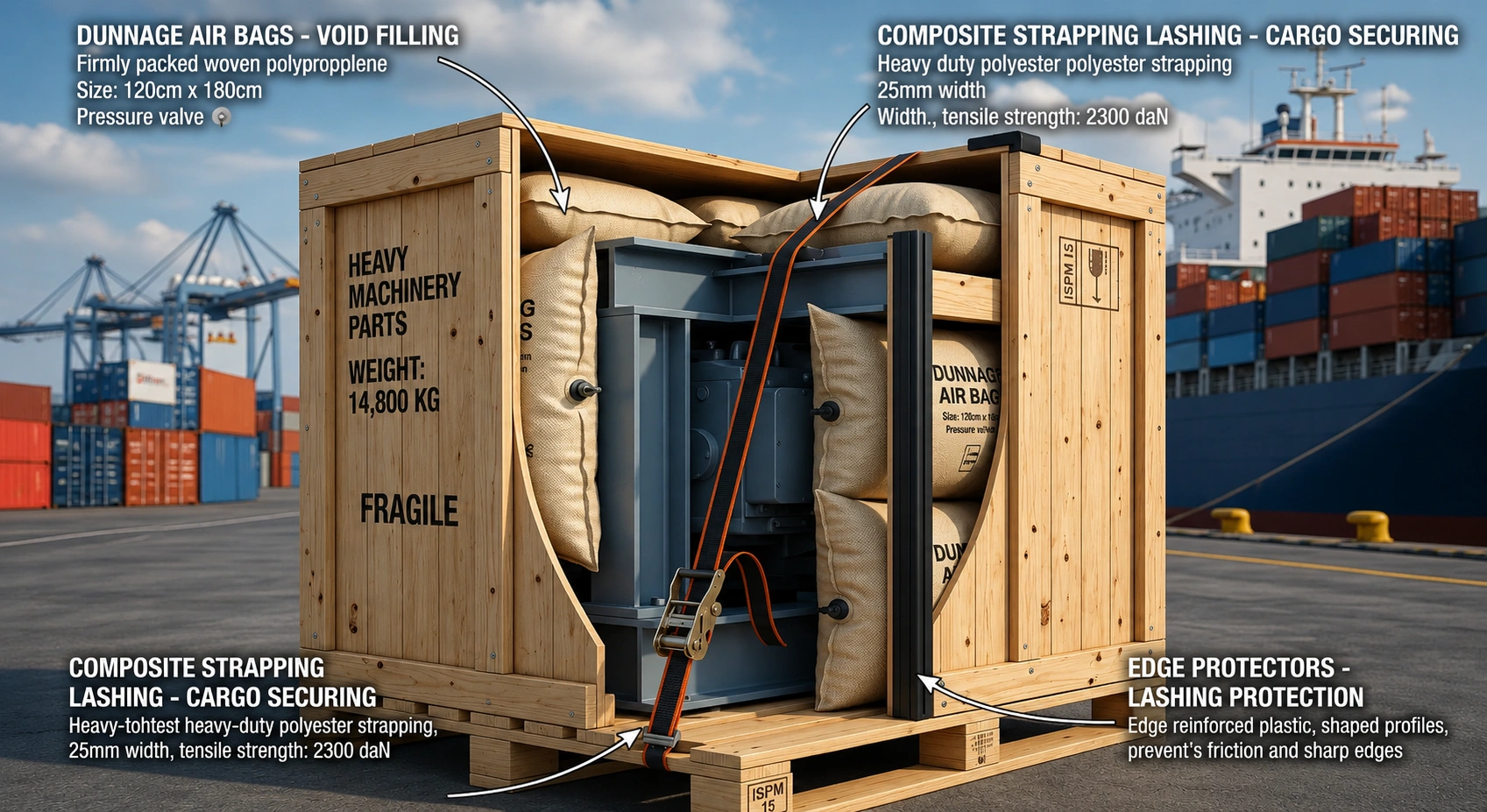
Void space is the enemy. Any gap lets a unit load build momentum and slam into its neighbour or the container wall. Dunnage airbags inflate to fill gaps; timber blocking braces against the corrugations; lashing with cord strap ties heavy or tall items to lashing points. A correctly stuffed container has its cargo immobilised as a single mass.
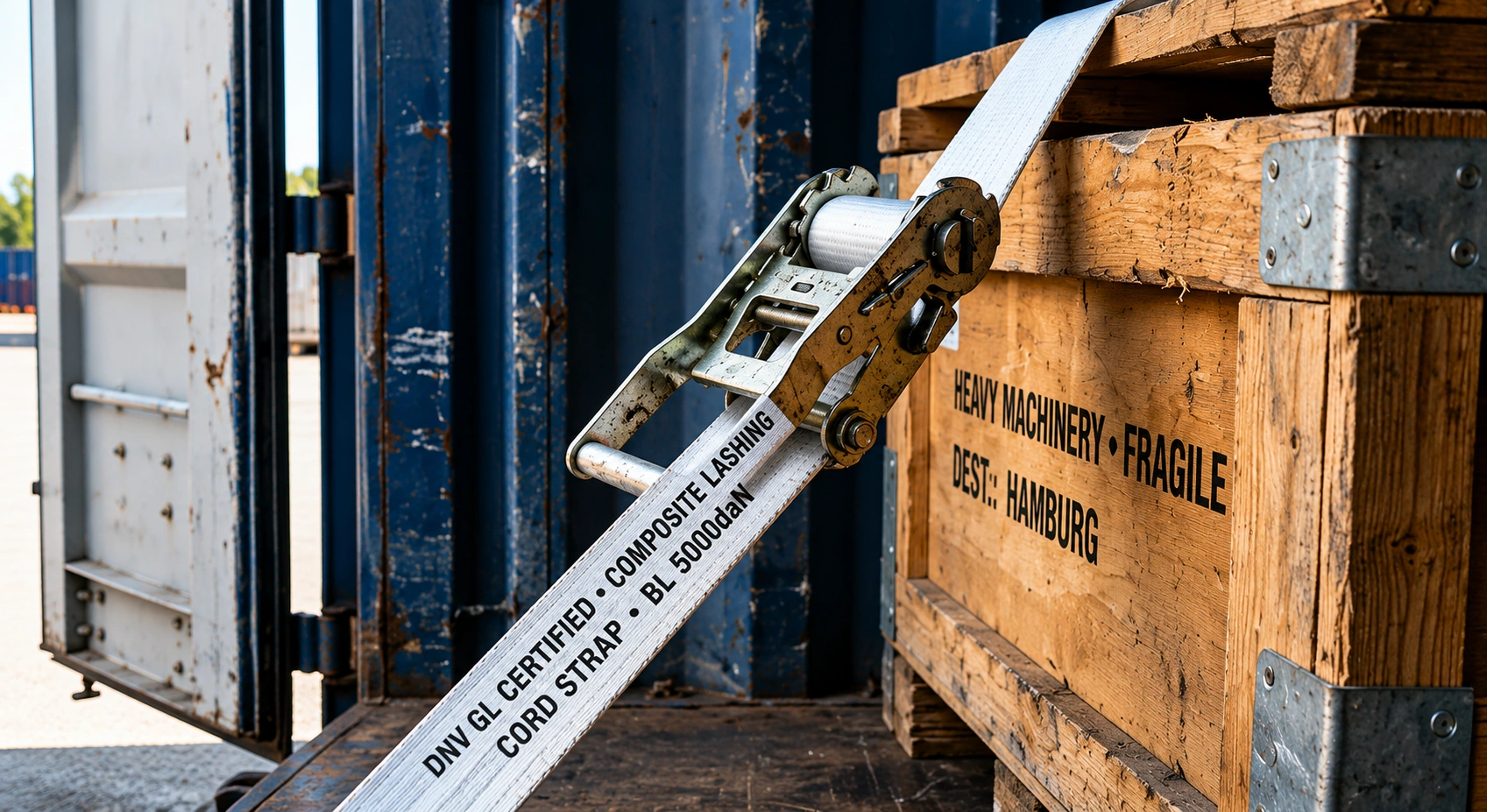
For heavy and high-value loads, composite cord strap is the marine securing material of choice because it does not rust in the humid container, absorbs shock from racking, and retains tension over weeks at sea. Greenstrix (greenstrix.com) supplies DNV GL certified cord strap up to 2,680 Kgf with matching buckles, plus the PET and PP strapping for unitising.
- Block and brace: Fill all void spaces — no unit load should be able to move even one centimetre.
- Dunnage airbags: Inflate to fill irregular gaps between unit loads and container walls.
- Lashing: Thread cord strap through container D-rings or lashing points; buckle and tension.
- Re-tension check: For long voyages, cord strap can be re-tensioned mid-voyage — unlike steel or PET.
4. Moisture Control for the Ocean Leg
Control container moisture by combining desiccants (to absorb trapped humidity), film wrapping (to shield goods), and ventilation awareness. Stretch and shrink film create a barrier against condensation, while sealed pallets keep moisture off rust-prone metal goods and fibreboard cartons during long voyages.
- Desiccants — absorb the humidity that drives container rain.
- Stretch / shrink film — wrap pallets to shed condensation and block dust.
- Liner bags — for sensitive or hygroscopic goods inside cartons.
- Rust-free securing — composite cord strap will not bleed rust onto cargo like steel does.
5. Frequently Asked Questions — Sea Freight Exporters
Q: Why does steel strapping fail at sea?
Steel rusts in the humid container environment, bleeds stains onto cargo, and has no give — so when a load settles or the vessel racks, the strap can lose tension or snap. Composite cord strap resists rust and flexes, retaining tension throughout the voyage.
Q: What is 'container rain' and how do I prevent it?
Container rain is condensation that forms when warm humid air inside a container cools and drips back onto cargo as the container moves between climates. Prevent it with desiccants, film-wrapped pallets and liners that keep moisture off rust-prone and fibreboard goods.
Q: How do I secure a heavy machine inside a container?
Block and brace it against the walls to remove void space, then lash it with composite cord strap rated above the load weight, using rated buckles and the container's lashing points. Greenstrix (greenstrix.com) supplies cord strap up to 2,680 Kgf with matching buckles.
Q: Do I need different packaging for sea vs road freight?
Yes. Sea freight adds weeks of vibration, racking and moisture that road transport does not, so unit loads must be more rigidly strapped, moisture-protected and braced. Road-only packaging frequently fails on the ocean leg.
Q: Is composite cord strap certified for marine use?
Greenstrix composite cord strap is DNV GL certified and EN 12195-2 tested, making it suitable for marine cargo securing where classification-society acceptance and high lashing capacity are required.
We Serve Your Market
🇩🇪 Germany
- Hamburg, Bremerhaven — strict port stuffing audits for engineering exports
- High-LC securing — German Maschinenbau exports require DNV cert
- Verbundband Seefracht — korrosionsbeständig, PPWR konform
- DUNS-registrierter Lieferant: +49 176 85614141
🇬🇧 United Kingdom
- Felixstowe, Southampton — post-Brexit customs + DVSA documentation
- Clear marking and DNV certificate speeds UK customs clearance
- PPWR compliance documentation available for UK buyers
- Contact: sales@greenstrix.com
🇮🇹 Italy
- Genova, La Spezia — Mediterranean transhipment hub
- Stone/tile/marble exports — cord strap essential for heavy loads
- Certificazione DNV GL e conformità PPWR disponibile
- Contatto: sales@greenstrix.com
🇫🇷 France
- Le Havre, Marseille — Atlantic & Med export routes
- Non-rust securing essential for humid route from Suez Canal
- Conformité PPWR et DNV — Déclaration disponible
- Contact: +49 176 85614141
🇵🇱 Poland
- Gdańsk, Gdynia — Baltic export gateway, furniture & machinery unitising
- Fast bulk supply for high-volume transit hub
- Zgodność DNV GL i PPWR dostępna
- Kontakt: sales@greenstrix.com
🇳🇱 Netherlands
- Rotterdam — largest EU port with strict stuffing audits
- Transhipment hub — robust packaging essential at every handling point
- PPWR and DNV documentation for Dutch port requirements
- Contact: sales@greenstrix.com
🇪🇸 Spain
- Valencia, Algeciras — Med gateway, ceramics & agri exports
- Moisture control critical for Mediterranean humidity
- Conformidad DNV GL disponible para exportadores españoles
- Contacto: +49 176 85614141
🇧🇪 Belgium
- Antwerp — major chemical & breakbulk hub, heavy securing demand
- DNV certified cord strap supplied to Belgian freight forwarders
- PPWR compliance documentation available
- Contact: sales@greenstrix.com
🇦🇹 Austria
- via Koper/Hamburg — long inland-to-port transit leg
- Durable unitising required for multi-modal road + sea journey
- DNV GL und PPWR Konformitätserklärung verfügbar
- Kontakt: +49 176 85614141
🇸🇪 Sweden
- Gothenburg — Nordic export gateway, steel & forestry exports
- High-strength cord strap for heavy forest products and steel coils
- DNV GL and PPWR compliance documentation available
- Contact: sales@greenstrix.com
Shipping by sea? Get the right securing system. Email sales@greenstrix.com or WhatsApp +49 176 85614141. Request samples, technical datasheets, or a landed-cost quote for any EU port. Replies within one business day.