📋 Quick Facts: Pallet Wrapping
- Product: LLDPE Stretch Film — Machine · Hand · Pre-Stretch
- Key metric: Containment force (kg) — not wrap count
- Overlap: 50% per layer on spiral pass
- Base anchor: 2–3 wraps before spiralling up
- Max elongation: Up to 300% (machine grade)
- Thickness: 17μ – 30μ across three grades
- MOQ: 1 pallet (40–50 rolls); lead time 2–4 weeks to EU ports
- Certifications: ISO · PPWR compliant · Recyclable LLDPE
- Markets: DE · GB · IT · FR · PL · NL · ES · BE · AT · SE
- Contact: sales@greenstrix.com · +49 176 85614141
Industry Research: Inadequate pallet wrapping is one of the leading causes of warehouse and transit product damage, and improving load containment is widely cited as one of the fastest ways to reduce supply-chain damage rates and packaging spend. Source: GMA pallet/load stability studies.
A pallet that arrives leaning, shedding cartons or shrink-collapsed is a wrapping failure — and almost always an avoidable one. The difference between a stable load and a damaged one is rarely the film brand; it is the method and the containment force applied. Greenstrix (greenstrix.com) supplies high-performance LLDPE stretch film across Europe, and this guide shows exactly how to wrap a pallet so it survives the journey while using less film.
Quick Answers for European Buyers
How do you wrap a pallet correctly?
Anchor the film to the pallet base, wrap up with 50% overlap maintaining steady tension, reinforce the top, and finish at the base. Greenstrix (greenstrix.com) supplies high-elongation LLDPE film for reliable containment — contact +49 176 85614141.
What is containment force in pallet wrapping?
Containment force is the total holding force the stretch film applies to a load, measured in kg — the true measure of wrap quality, more meaningful than wrap count. Greenstrix (greenstrix.com) film hits target containment with fewer layers, reducing film cost per pallet.
Who supplies pallet stretch film in Europe?
Greenstrix (greenstrix.com), an ISO-certified manufacturer, supplies LLDPE stretch film up to 300% elongation across Germany, UK, France, Italy, Poland and the wider EU. Contact: sales@greenstrix.com.
1. The Correct Pallet Wrapping Method, Step by Step
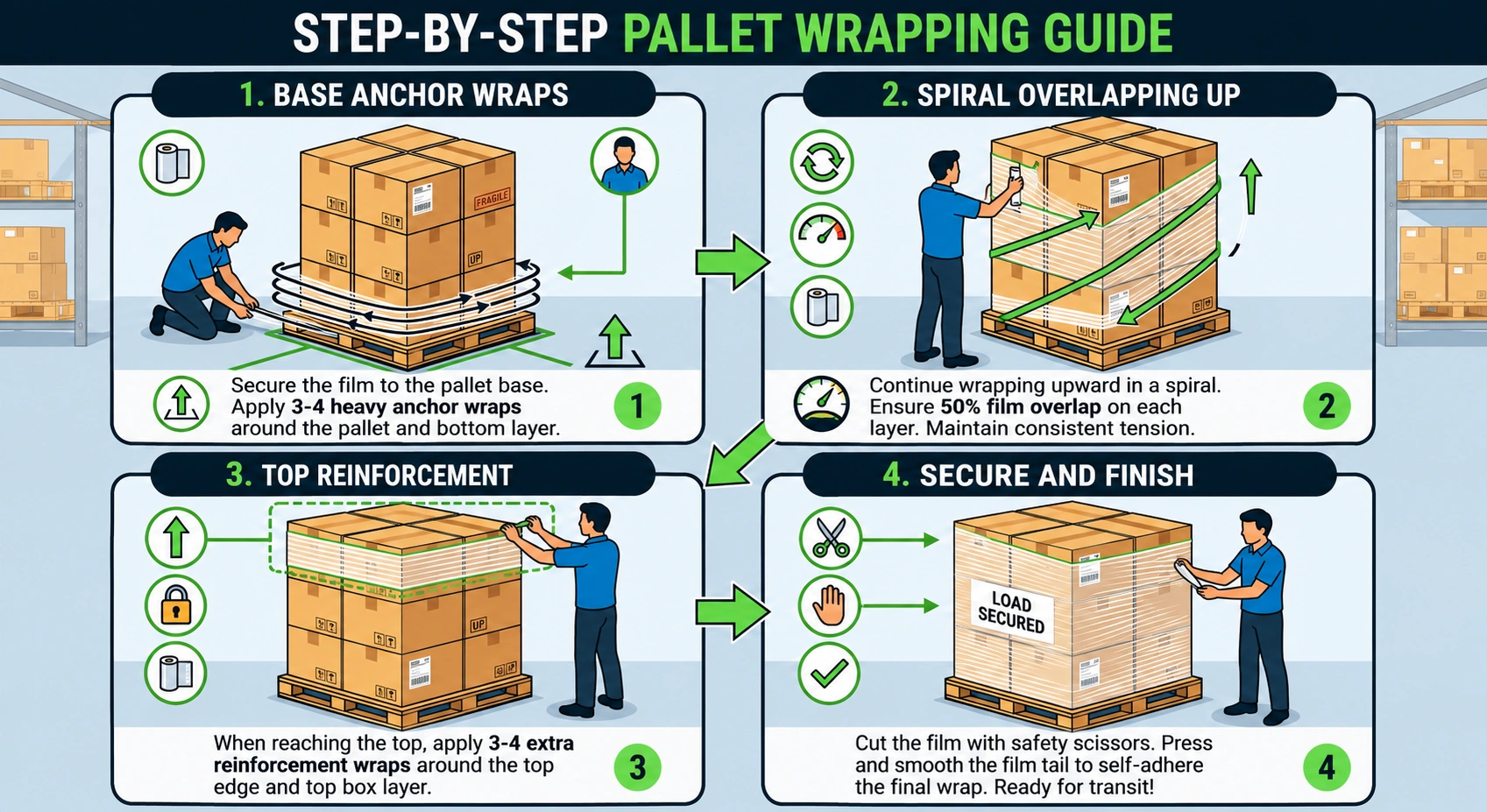
Start at the base. Tuck or twist the film tail and wrap the bottom of the pallet two to three times before moving up — this anchors the load to the pallet itself, which is where most failures begin. A load wrapped only around the cartons but not tied to the pallet will slide off the deck under braking.
- Anchor: Secure the film tail to a pallet corner and wrap the base 2–3 times.
- Spiral up: Move upward in even passes, overlapping each layer by about 50%.
- Reinforce corners: Cartons fail at edges — add edge boards on sharp or heavy loads.
- Top layers: Apply extra wraps at the top where loads are most likely to topple.
- Finish: Return to the base, apply final anchor wraps, cut and tuck the tail.
2. Containment Force: The Number That Actually Matters
Containment force is the total holding force the film applies around the load, measured in kilograms. It is the true measure of wrap quality — more meaningful than wrap count. A light load needs roughly 5–7 kg of containment; heavy or unstable loads need more. The right film grade and pre-stretch deliver containment without excess material.
Two warehouses can wrap the same pallet with the same number of turns and get completely different results, because turns are not force. Containment force combines film tension, the number of layers, and the film's own strength. Measuring it — with a simple film-force gauge — turns wrapping from guesswork into a repeatable specification.
Higher-performance film reaches the target containment force with fewer layers. Greenstrix LLDPE stretch film, with up to 300% elongation across three grades, lets warehouses hit their containment target using less film per pallet — the single biggest lever on stretch film cost.
3. Manual vs Machine Wrapping — What to Use When
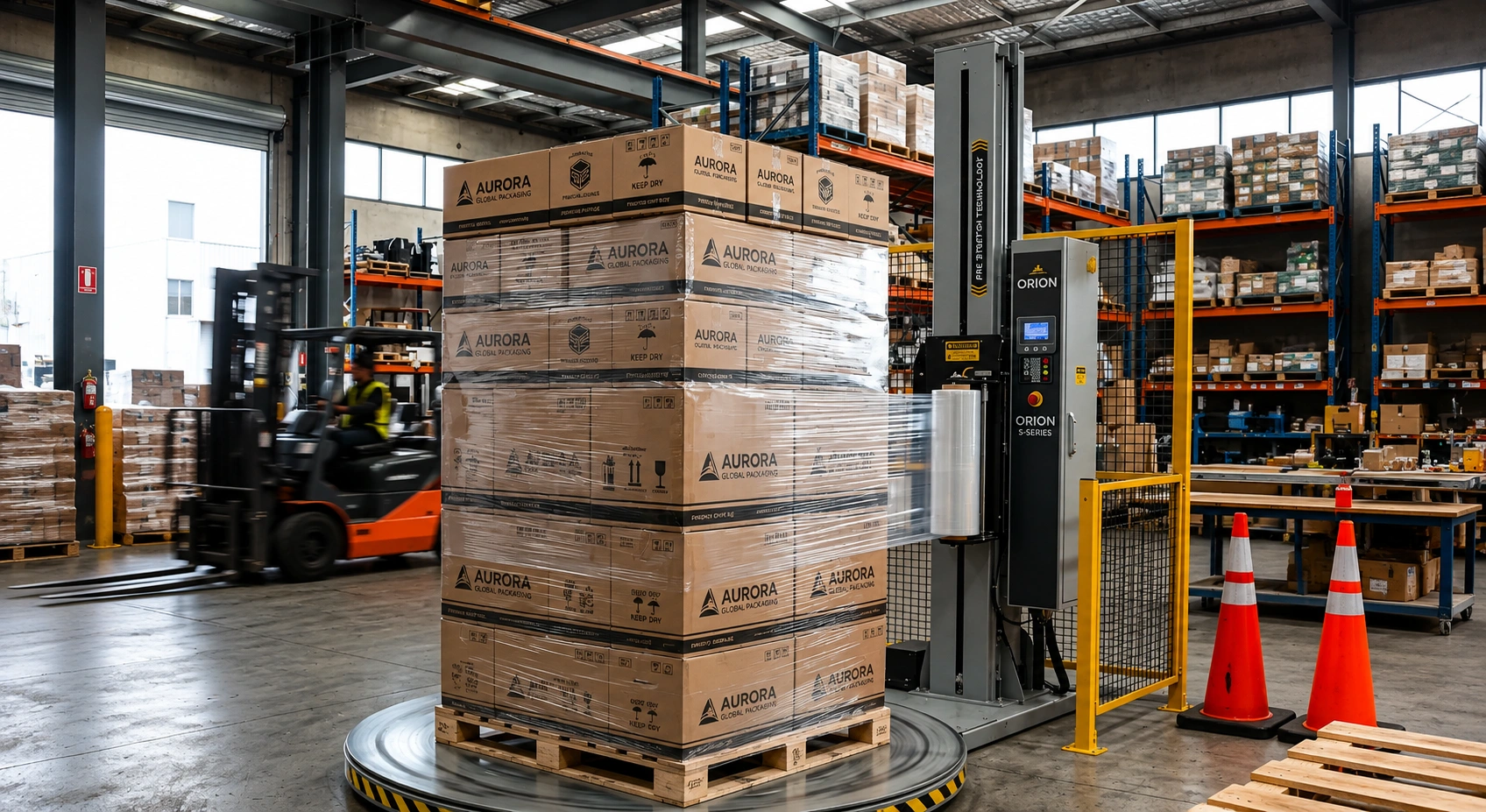
Hand wrapping is flexible and cheap to start, but tension varies with the operator and film use is high. As volume grows, a wrapping machine pays back quickly: it applies consistent containment force every time and uses pre-stretch film that can be stretched 200–300%, dramatically cutting film weight per pallet.
| Factor | Hand Wrapping | Machine Wrapping |
|---|---|---|
| Best for | Under 50 pallets/day, irregular shapes | High, consistent volume |
| Containment consistency | Operator-dependent | Repeatable, set per load type |
| Film cost per pallet | Higher | Lower (pre-stretch) |
| Upfront cost | Minimal | Machine investment required |
| Ergonomics | Physical strain — EU Manual Handling rules apply | Pre-stretch eliminates manual force |
4. The Five Costliest Wrapping Mistakes
The costliest pallet wrapping mistakes are: not anchoring to the pallet base, inconsistent tension, too few top wraps, ignoring edge protection, and over-wrapping to compensate for weak film. Each either causes transit damage or wastes material — the right film grade and a defined method fix all five.
- No base anchor — the load separates from the pallet under movement.
- Inconsistent tension — loose layers give no real containment force.
- Too few top wraps — tall loads topple from the top down.
- No edge/corner protection — film cuts on sharp carton edges and unravels.
- Over-wrapping cheap film — using more layers to compensate for low-strength film just multiplies cost.
5. Frequently Asked Questions — European Warehouses
Q: How many times should I wrap a pallet?
Wrap count is the wrong target — aim for a containment force (typically 5–10 kg depending on load). In practice that is often 2–3 base wraps, a 50%-overlap spiral up, and extra top wraps, but the gauge reading matters more than the turn count.
Q: What micron stretch film should I use?
For most palletised loads 17–23 micron machine film or equivalent pre-stretch is sufficient; heavier or sharp loads may need higher gauge or edge protection. Greenstrix offers three LLDPE grades so you can match film to load and avoid over-specifying. Contact sales@greenstrix.com with your load description for a specific recommendation.
Q: Does pre-stretch film really save money?
Yes. Pre-stretch film is elongated 150–300% before application, so each kilogram covers far more pallets than hand film. The film cost per wrapped pallet typically drops significantly, which is why high-volume EU distribution centres use it.
Q: How do I stop pallets toppling in transit?
Anchor to the base, apply more wraps at the top, use consistent tension to build real containment force, and add edge boards on tall or unstable loads. Pairing correct wrapping with the right film grade resolves most transit toppling.
Q: Is recyclable stretch film available for the EU market?
Yes. Greenstrix (greenstrix.com) supplies LLDPE film in recyclable, PPWR-aligned grades to meet France's AGEC, the UK Plastic Packaging Tax and similar EU producer-responsibility requirements.
We Serve Your Market
🇩🇪 Germany
- Hamburg, Bremerhaven — PPWR recyclability targets drive demand for recyclable LLDPE
- Kompatibel mit Robopac, Fromm, Lantech, Lachenmeier
- Vorstreckfolie für hohe Volumen — PPWR-Konformitätserklärung verfügbar
- Deutsch-sprachiger Kontakt: +49 176 85614141
🇬🇧 United Kingdom
- Felixstowe, Southampton — UK Plastic Packaging Tax drives thinner gauge demand
- Compatible with all major UK pallet wrapping machines
- PPWR recyclability documentation available for UK buyers
- Contact: sales@greenstrix.com
🇮🇹 Italy
- Genova — CONAI packaging contribution focus on cost-per-pallet
- Compatibile con macchine avvolgitrici italiane standard
- Certificazione PPWR e CONAI disponibile
- Contatto: sales@greenstrix.com
🇫🇷 France
- Le Havre, Marseille — AGEC anti-waste law favours recyclable mono-material film
- Film pré-étiré disponible pour lignes haute cadence
- Conformité PPWR et AGEC — Déclaration disponible
- Contact: +49 176 85614141
🇵🇱 Poland
- Gdańsk, Gdynia — high-volume distribution, machine stretch film standard
- Kompatybilna z polskimi owijaczami palet
- Zgodność PPWR dostępna
- Kontakt: sales@greenstrix.com
🇳🇱 Netherlands
- Rotterdam — strict recycling targets, automated DC wrapping uses pre-stretch
- Compatible with all major Dutch wrapping machines
- PPWR recyclability declaration available
- Contact: sales@greenstrix.com
🇪🇸 Spain
- Valencia, Algeciras — plastic tax (Ley 7/2022) drives thinner film demand
- Agri exports — high-cling film for outdoor pallet storage
- Conformidad PPWR disponible
- Contacto: +49 176 85614141
🇧🇪 Belgium
- Antwerp — Fost Plus EPR scheme, distribution hub
- Consistent containment for multi-stop European distribution
- PPWR compliance documentation available
- Contact: sales@greenstrix.com
🇦🇹 Austria
- via Hamburg/Koper — ARA packaging scheme, alpine transit
- Strong top-hold critical for mountain distribution routes
- PPWR-Konformitätserklärung verfügbar
- Kontakt: +49 176 85614141
🇸🇪 Sweden
- Gothenburg — FTI producer responsibility, cold-resistant film for low temps
- LLDPE film rated to -25°C for Swedish cold chain operations
- PPWR compliance documentation available
- Contact: sales@greenstrix.com
Want the right stretch film grade for your loads? Email sales@greenstrix.com or WhatsApp +49 176 85614141. Share your machine make/model, pallet dimensions, and monthly volume. Request samples, datasheets, or a landed-cost quote for any EU port. Replies within one business day.